AAAI 2026

January 23, 2026

Singapore, Singapore

Would you like to see your presentation here, made available to a global audience of researchers?
Add your own presentation or have us affordably record your next conference.

Competency Questions (CQs) play a crucial role in validating ontology design. While manually crafting CQs can be highly time-consuming and costly for ontology engineers, recent studies have explored the use of large language models (LLMs) to automate this process. However, prior approaches have largely evaluated generated CQs based on their similarity to existing datasets, which often fail to verify semantic pitfalls such as “Misusing allValuesFrom”. Since such pitfalls cannot be reliably detected through rule-based methods, we propose a novel dataset and model of Validating Semantic Pitfalls in Ontology (VSPO) for CQ generation specifically designed to verify the semantic pitfalls. To simulate missing and misused axioms, we use LLM to generate natural language definitions of classes and properties and introduce misalignments between the definitions and the ontology by removing axioms or altering logical operators (e.g., substituting union with intersection). We then fine-tune LLaMA-3.1-8B-Instruct to generate CQs that validate these semantic discrepancies between the provided definitions and the corresponding axioms. The resulting CQs can detect a broader range of modeling errors compared to existing public datasets. Our fine-tuned model demonstrates superior performance over baselines, showing 26% higher precision and 28.2% higher recall than GPT-4.1 in generating CQs for pitfall validation. This research enables automatic generation of TBox-validating CQs using LLMs, significantly reducing manual effort while improving semantic alignment between ontologies and expert knowledge. To the best of our knowledge, this is the first study to target semantic pitfall validation in CQ generation using LLMs.

Downloads

SlidesPaperTranscript English (automatic)

Next from AAAI 2026

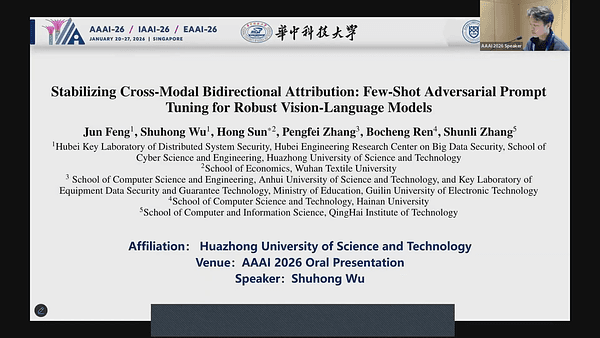
Stabilizing Cross-Modal Bidirectional Attribution: Few-Shot Adversarial Prompt Tuning for Robust Vision-Language Models
technical paper

Stabilizing Cross-Modal Bidirectional Attribution: Few-Shot Adversarial Prompt Tuning for Robust Vision-Language Models

AAAI 2026

+3
Jun Feng and 5 other authors

23 January 2026

Stay up to date with the latest Underline news!

Select topic of interest (you can select more than one)

PRESENTATIONS

  • All Presentations
  • For Librarians
  • Resource Center
  • Free Trial
Underline Science, Inc.
1216 Broadway, 2nd Floor, New York, NY 10001, USA

© 2025 Underline - All rights reserved