AAAI 2026

January 22, 2026

Singapore, Singapore

Would you like to see your presentation here, made available to a global audience of researchers?
Add your own presentation or have us affordably record your next conference.

The demand for long-context processing in large language models (LLMs) continues to escalate alongside rapid advancements in their capabilities. However, the intermediate attention keys and values (KV cache) employed to avoid re-computations, also grow linearly with sequence length, far exceeding the memory capacity of consumer-grade GPUs. Consequently, many studies have proposed KV cache compression methods that evict unimportant tokens based on variant attention scoring strategies. These methods typically retain the KV pairs of the top-k scoring tokens under a fixed memory budget. However, they still face several limitations. First, they disregard the activation frequency of tokens, specifically the count of times tokens achieve top-k scores in the attention distribution of following tokens. The methods based on variant attention scores may incorrectly evict some high-activation-frequency yet low final-scoring tokens. Second, the activation frequency exhibits different distribution patterns across layers and tasks. Neglecting these differences negatively impacts model performance and task adaptability. Our analysis of the actual token activation frequency and its unique characteristics across layers and task types reveals potential opportunities to address these issues. In this paper, we propose HitKV, which employs hit rates to directly characterize token activation frequencies, enabling adaptive layer-aware and task-aware KV cache eviction under the uniform memory allocation strategies. Also, HitKV can be easily integrated into layer-specific memory allocation methods. Experimental results demonstrate that HitKV maintains model performance with preserving only 3\% of the KV cache, achieves high-quality generation outputs in long-text generations tasks, and delivers $4\times$ throughput improvement over baselines.

Downloads

SlidesPaperTranscript English (automatic)

Next from AAAI 2026

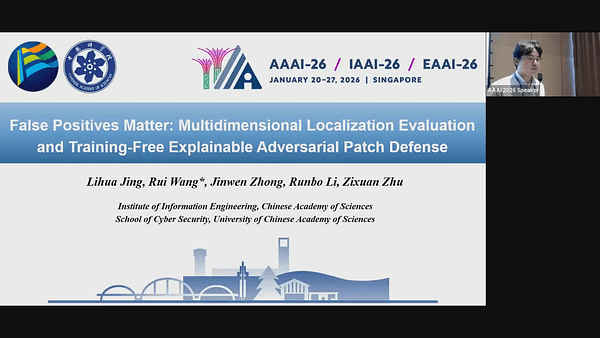
False Positives Matter: Multidimensional Localization Evaluation and Training-Free Explainable Adversarial Patch Defense
technical paper

False Positives Matter: Multidimensional Localization Evaluation and Training-Free Explainable Adversarial Patch Defense

AAAI 2026

+2
Lihua Jing and 4 other authors

22 January 2026

Stay up to date with the latest Underline news!

Select topic of interest (you can select more than one)

PRESENTATIONS

  • All Presentations
  • For Librarians
  • Resource Center
  • Free Trial
Underline Science, Inc.
1216 Broadway, 2nd Floor, New York, NY 10001, USA

© 2025 Underline - All rights reserved