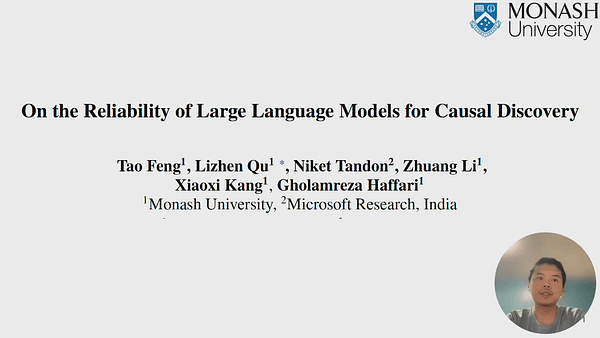
AAAI 2026 Main Conference

January 24, 2026

Singapore, Singapore

Would you like to see your presentation here, made available to a global audience of researchers?
Add your own presentation or have us affordably record your next conference.

Large Language Models (LLMs) and causal learning each hold strong potential for clinical decision making (CDM). However, their synergy remains poorly understood, largely due to the lack of systematic benchmarks evaluating their integration in clinical risk prediction. In real-world healthcare, identifying features with causal influence on outcomes is crucial for actionable and trustworthy predictions. While recent work highlights LLMs' emerging causal reasoning abilities, there lacks comprehensive benchmarks to assess their causal learning and performance informed by causal features in clinical risk prediction. To address this, we introduce REACT-LLM, a benchmark designed to evaluate whether combining LLMs with causal features can enhance clinical prognostic performance and potentially outperform traditional machine learning (ML) methods. Unlike existing LLM-clinical benchmarks that often focus on a limited set of outcomes, REACT-LLM evaluates 7 clinical outcomes across 2 real-world datasets, comparing 15 prominent LLMs, 6 traditional ML models, and 3 causal discovery (CD) algorithms. Our findings indicate that while LLMs perform reasonably in clinical prognostics, they have not yet outperformed traditional ML models. Integrating causal features derived from CD algorithms into LLMs offers limited performance gains, primarily due to the strict assumptions of many CD methods, which are often violated in complex clinical data. While the direct integration yields limited improvement, our benchmark reveals a more promising synergy: LLMs serve effectively as knowledge-rich collaborators for identifying and optimizing causal features. Additionally, in-context learning improves LLM predictions when prompts are tailored to the task and model. Different LLMs show varying sensitivity to structured data encoding formats, for example, open-source models perform better with JSON, while smaller models benefit from narrative serialization. These findings highlight the need to match prompts and data formats to model architecture and pretraining. Our code is publicly available at: https://github.com/LinnaWang-Lena/REACT_LLM.

Downloads

SlidesPaper

Next from AAAI 2026 Main Conference

Gait Transformer: End-to-End Transformer Backbone for Gait Recognition
poster

Gait Transformer: End-to-End Transformer Backbone for Gait Recognition

AAAI 2026 Main Conference

+3
Saihui Hou and 5 other authors

24 January 2026

Stay up to date with the latest Underline news!

Select topic of interest (you can select more than one)

PRESENTATIONS

  • All Presentations
  • For Librarians
  • Resource Center
  • Free Trial
Underline Science, Inc.
1216 Broadway, 2nd Floor, New York, NY 10001, USA

© 2025 Underline - All rights reserved