Content not yet available

This lecture has no active video or poster.

AAAI 2026

January 22, 2026

Singapore, Singapore

Would you like to see your presentation here, made available to a global audience of researchers?
Add your own presentation or have us affordably record your next conference.

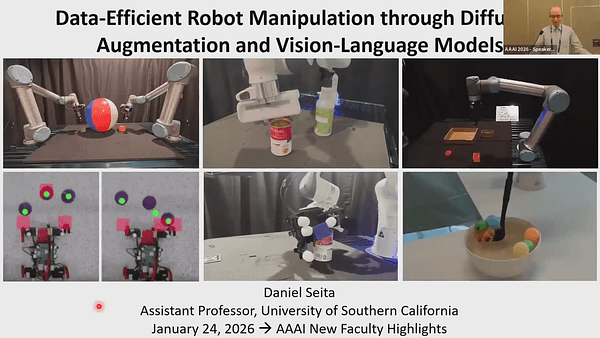
Imitation learning for robotic manipulation faces a fundamental challenge: the scarcity of large-scale, high-quality robot demonstration data. Recent robotic foundation models often pre-train on cross-embodiment robot datasets to increase data scale, while they face significant limitations as the diverse morphologies and action spaces across different robot embodiments make unified training challenging. In this paper, we present H-RDT (Human to Robotics Diffusion Transformer), a novel approach that leverages human manipulation data to enhance robot manipulation capabilities. Our key insight is that large-scale egocentric human manipulation videos with paired 3D hand pose annotations provide rich behavioral priors that capture natural manipulation strategies and can benefit robotic policy learning. We introduce a two-stage training paradigm: (1) pre-training on large-scale egocentric human manipulation data, and (2) cross-embodiment fine-tuning on robot-specific data with modular action encoders and decoders. Built on a diffusion transformer architecture with 2B parameters, H-RDT uses flow matching to model complex action distributions. The modular design of action encoder and decoder components enables effective knowledge transfer from the unified human embodiment to diverse robot platforms through efficient fine-tuning. Extensive evaluations encompassing both simulation and real-world experiments, single-task and multitask scenarios, as well as few-shot learning and robustness assessments, demonstrate that H-RDT outperforms training from scratch and existing state-of-the-art methods, including $\boldsymbol{\pi}_0$ and RDT, achieving significant improvements of 13.9% and 40.5% over training from scratch in simulation and real-world experiments, respectively. The results validate our core hypothesis that human manipulation data can serve as a powerful foundation for learning bimanual robotic manipulation policies.

Downloads

Paper

Next from AAAI 2026

Scene Experts: Specializing in 3D Gaussian Splatting with Adaptive Decomposition
poster

Scene Experts: Specializing in 3D Gaussian Splatting with Adaptive Decomposition

AAAI 2026

+5
Xiaowen Fu and 7 other authors

22 January 2026

Stay up to date with the latest Underline news!

Select topic of interest (you can select more than one)

PRESENTATIONS

  • All Presentations
  • For Librarians
  • Resource Center
  • Free Trial
Underline Science, Inc.
1216 Broadway, 2nd Floor, New York, NY 10001, USA

© 2025 Underline - All rights reserved