AAAI 2026

January 25, 2026

Singapore, Singapore

Would you like to see your presentation here, made available to a global audience of researchers?
Add your own presentation or have us affordably record your next conference.

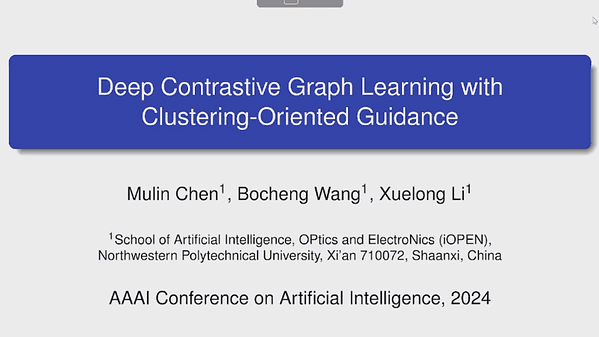
Graph-level clustering (GLC), which aims to group entire graphs according to their structural and attribute-based similarities, represents a fundamental yet challenging task in various practical applications. Existing GLC methods primarily fall into two main paradigms: 1) deep graph clustering approaches based on Graph Neural Networks (GNNs), and 2) kernel-based methods that utilize predefined kernels to perform fine-grained structural comparison for clustering. However, GNN-based methods typically learn graph-level representations by aggregating node embeddings through pooling operations, which inevitably leads to substantial information loss and suboptimal clustering performance. In contrast, kernel methods, despite their theoretical expressiveness, suffer from prohibitive computational costs that hinder their scalability to large-scale settings. To solve these issues, we propose a novel graph learning framework named Anchor-driven Nyström for Deep Graph-Level Clustering (ANGC), which computes graph similarity via kernel methods while retaining the scalability of GNNs. Specifically, we first employ GNNs to encode individual graphs into sets of node embeddings. Rather than relying on pooling operations, we compute graph similarities in a kernel space constructed from these embeddings. To enhance both scalability and representational power, we introduce learnable graph Nyström anchors, which support end-to-end optimization and significantly accelerate kernel computations. To further improve the discriminative capability of these anchors, we propose the concept of anchor response discrepancy, that is, the variation in a given anchor’s responses across different samples. By maximizing this discrepancy, the anchors are encouraged to strengthen inter-graph distinctions for better clustering. Extensive experiments demonstrate the effectiveness and superiority of ANGC over existing state-of-the-art methods.

Downloads

SlidesPaperTranscript English (automatic)

Next from AAAI 2026

The GATTACA Framework: Graph Neural Network-Based Reinforcement Learning for Controlling Biological Networks
technical paper

The GATTACA Framework: Graph Neural Network-Based Reinforcement Learning for Controlling Biological Networks

AAAI 2026

Andrzej Mizera and 1 other author

25 January 2026

Stay up to date with the latest Underline news!

Select topic of interest (you can select more than one)

PRESENTATIONS

  • All Presentations
  • For Librarians
  • Resource Center
  • Free Trial
Underline Science, Inc.
1216 Broadway, 2nd Floor, New York, NY 10001, USA

© 2025 Underline - All rights reserved