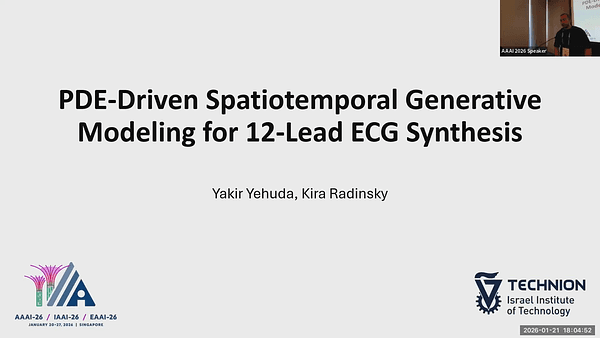
AAAI 2026

January 25, 2026

Singapore, Singapore

Would you like to see your presentation here, made available to a global audience of researchers?
Add your own presentation or have us affordably record your next conference.

The multi-lead electrocardiogram (ECG) stands as a cornerstone of cardiac diagnosis. Recent strides in electrocardiogram self-supervised learning (eSSL) have brightened prospects for enhancing representation learning without relying on high-quality annotations. Yet earlier eSSL methods suffer a key limitation: they focus on consistent patterns across leads and beats, overlooking the inherent differences in heartbeats rooted in cardiac conduction processes, while subtle but significant variations carry unique physiological signatures. Moreover, representation learning for ECG analysis should align with ECG diagnostic guidelines, which progress from individual heartbeats to single leads and ultimately to lead combinations. This sequential logic, however, is often neglected when applying pre-trained models to downstream tasks. To address these gaps, we propose CLEAR-HUG, a two-stage framework designed to capture subtle variations in cardiac conduction across leads while adhering to ECG diagnostic guidelines. In the first stage, we introduce an eSSL model termed Conduction-LEAd Reconstructor (CLEAR), which captures both specific variations and general commonalities across heartbeats. Treating each heartbeat as a distinct entity, CLEAR employs a simple yet effective sparse attention mechanism to reconstruct signals without interference from other heartbeats. In the second stage, we implement a Hierarchical lead-Unified Group head (HUG) for disease diagnosis, mirroring clinical workflow. Experimental results across six tasks show a 6.84\% improvement, validating the effectiveness of CLEAR-HUG. This highlights its ability to enhance representations of cardiac conduction and align patterns with expert diagnostic guidelines.

Downloads

Paper

Next from AAAI 2026

ORVIT: Near-Optimal Online Distributionally Robust Reinforcement Learning
poster

ORVIT: Near-Optimal Online Distributionally Robust Reinforcement Learning

AAAI 2026

George K. Atia and 2 other authors

25 January 2026

Stay up to date with the latest Underline news!

Select topic of interest (you can select more than one)

PRESENTATIONS

  • All Presentations
  • For Librarians
  • Resource Center
  • Free Trial
Underline Science, Inc.
1216 Broadway, 2nd Floor, New York, NY 10001, USA

© 2025 Underline - All rights reserved