Content not yet available
This lecture has no active video or poster.
Would you like to see your presentation here, made available to a global audience of researchers?
Add your own presentation or have us affordably record your next conference.
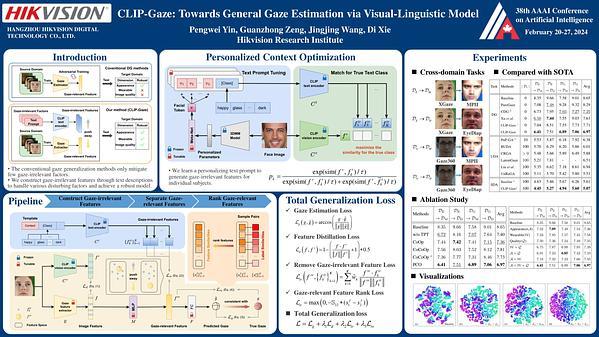
Appearance-based gaze estimation, aiming to predict accurate 3D gaze direction from a single facial image, has made promising progress in recent years. However, most methods suffer from heavy performance degradation when facing across-domain evaluation due to gaze-irrelevant factor interference, such as expressions, wearables, and image quality. To alleviate this problem, we present a novel Hybrid-domain Adaptative Representation Learning (shorted by HARL) framework that exploits multi-source hybrid datasets to learn robust gaze representation. More specifically, we propose to disentangle gaze-relevant representation from low-quality facial images by aligning features extracted from high-quality near-eye images in an unsupervised domain-adaptation manner, which hardly requires any computational or inference costs. Additionally, we also analyze the effect of head-pose and design a simple yet efficient sparse graph fusion module to explore the inner geometric constraint between gaze direction and head-pose, which leads to dense and robust gaze representation. Extensive experiments on EyeDiap, MPIIFaceGaze, and Gaze360 datasets demonstrate that our approach achieves state-of-the-art accuracy of $\textbf{5.02}^{\circ}$ and $\textbf{3.36}^{\circ}$, and $\textbf{9.26}^{\circ}$ respectively, and present completing performances through cross-datasets evaluation.