AAAI 2026

January 22, 2026

Singapore, Singapore

Would you like to see your presentation here, made available to a global audience of researchers?
Add your own presentation or have us affordably record your next conference.

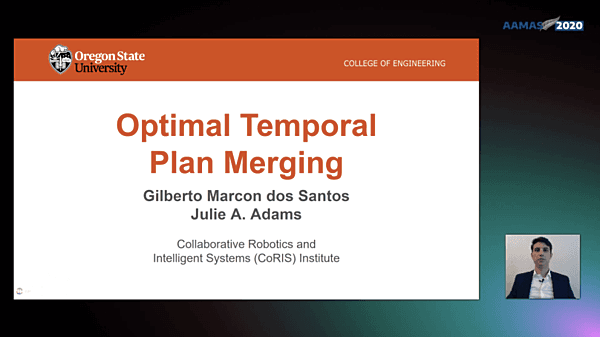
Modern planning systems utilize various plan representations - sequential, parallel, partially ordered (PO), and partial-order causal link (POCL) - each with different models for concurrency. These formalisms are often implicitly assumed to have the same base properties, particularly regarding makespan. We challenge this assumption, proving the relationship between them is fundamentally asymmetric. Our analysis shows conversions from plans with rigid concurrency layers (sequential, parallel) to those with flexible partial orders (PO, POCL) can preserve makespan. However, the reverse generally fails; the flexible orderings in PO/POCL plans can yield shorter makespans for solutions that cannot be represented in parallel plans without serialization. We prove that finding an optimal parallel representation for a given POCL plan is $\textsf{NP}$-complete, resolving a key question about their practical interchangeability. We also provide tight complexity bounds for makespan-bounded plan existence. Notably, our results disprove a claim in the literature that planning graph-based planners maximize concurrency by minimizing the critical path in derived PO plans.

Downloads

SlidesPaperTranscript English (automatic)

Next from AAAI 2026

Exploiting Geometric Structures for Modeling Multi-Agent Behaviors: A New Thinking
technical paper

Exploiting Geometric Structures for Modeling Multi-Agent Behaviors: A New Thinking

AAAI 2026

+4
Xiaofeng Cao and 6 other authors

22 January 2026

Stay up to date with the latest Underline news!

Select topic of interest (you can select more than one)

PRESENTATIONS

  • All Presentations
  • For Librarians
  • Resource Center
  • Free Trial
Underline Science, Inc.
1216 Broadway, 2nd Floor, New York, NY 10001, USA

© 2025 Underline - All rights reserved