Would you like to see your presentation here, made available to a global audience of researchers?
Add your own presentation or have us affordably record your next conference.
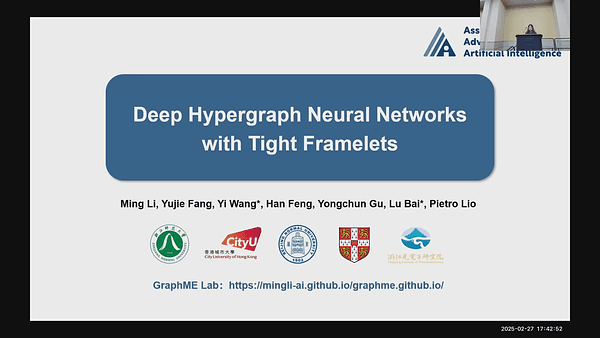
Hypergraph neural networks (HGNNs) have shown great potential in modeling higher-order relationships among multiple entities. However, most existing HGNNs primarily emphasize low-pass filtering while neglecting the role of high-frequency information. In this work, we present a theoretical investigation into the spectral behavior of HGNNs and prove that combining both low-pass and high-pass components leads to more expressive and effective models. Notably, our analysis highlights that high-pass signals play a crucial role in capturing local discriminative structures within hypergraphs. Guided by these insights, we propose a novel sheaflet-based HNNs that integrates cellular sheaf theory and framelet transforms to preserve higher-order dependencies while enabling multi-scale spectral decomposition. This framework explicitly emphasizes high-pass components, aligning with our theoretical findings. Extensive experiments on benchmark datasets demonstrate the superiority of our approach over existing methods, validating the importance of high-frequency information in hypergraph learning.