AAAI 2026 Main Conference

January 23, 2026

Singapore, Singapore

Would you like to see your presentation here, made available to a global audience of researchers?
Add your own presentation or have us affordably record your next conference.

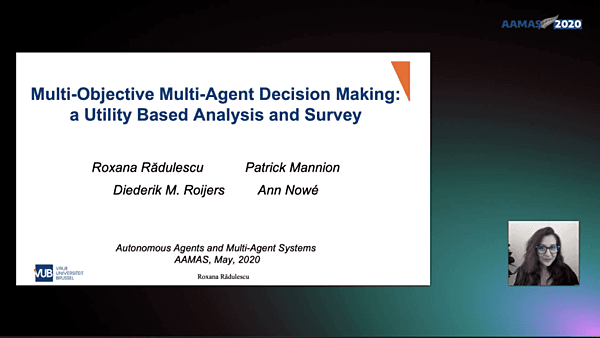
Multi-agent multi-objective systems (MAMOS) have emerged as powerful frameworks for modelling complex decision-making problems across various real-world domains, such as robotic exploration, autonomous traffic management, and sensor network optimisation. MAMOS offer enhanced scalability and robustness through decentralised control and more accurately reflect inherent trade-offs between conflicting objectives. In MAMOS, each agent uses utility functions that map return vectors to scalar values. Existing MAMOS optimisation methods face challenges in handling heterogeneous objective and utility function settings, where training non-stationarity is intensified due to private utility functions and the associated policies. In this paper, we first theoretically prove that direct access to, or structured modeling of, global utility functions is necessary for the Bayesian Nash Equilibrium under decentralised execution constraints. To access the global utility functions while preserving the decentralised execution, we propose an Agent-Attention Multi-Agent Multi-Objective Reinforcement Learning (AA-MAMORL) framework. Our approach implicitly learns a joint belief over other agents’ utility functions and their associated policies during centralised training, effectively mapping global states and utilities to each agent's policy. In execution, each agent independently selects actions based on local observations and its private utility function to approximate a BNE, without relying on inter-agent communication. We conduct comprehensive experiments in both a custom-designed MAMO Particle environment and the standard MOMALand benchmark. The results demonstrate that the accessibility to global preferences and our proposed AA-MAMORL significantly improves performance and consistently outperforms state-of-the-art methods.

Downloads

SlidesPaper

Next from AAAI 2026 Main Conference

Flowing Backwards: Improving Normalizing Flows via Reverse Representation Alignment
poster

Flowing Backwards: Improving Normalizing Flows via Reverse Representation Alignment

AAAI 2026 Main Conference

+5
Yang Chen and 7 other authors

23 January 2026

Stay up to date with the latest Underline news!

Select topic of interest (you can select more than one)

PRESENTATIONS

  • All Presentations
  • For Librarians
  • Resource Center
  • Free Trial
Underline Science, Inc.
1216 Broadway, 2nd Floor, New York, NY 10001, USA

© 2025 Underline - All rights reserved