Content not yet available
This lecture has no active video or poster.
Would you like to see your presentation here, made available to a global audience of researchers?
Add your own presentation or have us affordably record your next conference.
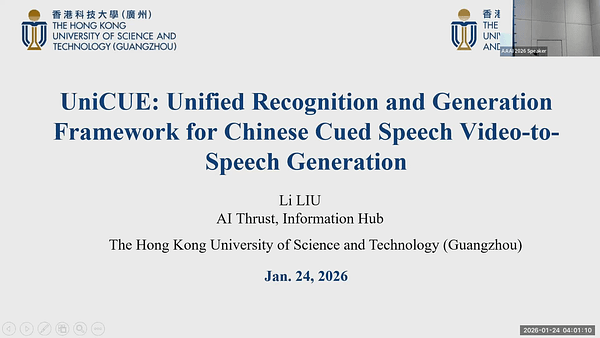
Automatic Cued Speech Recognition (ACSR) is a vital communication system designed to enhance spoken language accessibility for the hearing-impaired by combining lip movements and hand gestures to encode phonemes. Despite its effectiveness, current ACSR methods face significant challenges, including poor generalization to unseen cuers due to the limited scale of CS datasets, which restricts the ability of existing visual encoder to capture cuer-invariant CS visual features. Additionally, previous approaches relying on Connectionist Temporal Classification (CTC) decoding fail to incorporate prior linguistic sequence knowledge, further limiting their performance. To address these issues, we propose a novel Two Auxiliary Modalities guided Cross-cuer Invariant Adaptation method (TACIA), introducing pose and text modalities to help extract cuer-invariant motion and semantic features, thereby improving generalization. In addition, we introduce a Visual-guided Cued Token Prediction (VG-NTP) method, inspired by large language models. This method replaces CTC decoding by incorporating language modeling, leveraging rich linguistic knowledge, including semantics, to address the suboptimal issues present in the CTC decoding process. Extensive experiments demonstrate the superiority of our approach to the state-of-the-art (SOTA) on Chinese and British CS datasets, significantly advancing the accuracy and quality of ACSR systems.