AAAI 2026

January 22, 2026

Singapore, Singapore

Would you like to see your presentation here, made available to a global audience of researchers?
Add your own presentation or have us affordably record your next conference.

Reinforcement learning (RL) has been recognized as a powerful tool for robot control tasks. RL typically employs reward functions to define task objectives and guide agent learning. However, since the reward function serves the dual purpose of defining the optimal goal and guiding learning, it is challenging to design the reward function manually, which often results in a suboptimal task representation. To tackle the reward design challenge in RL, inspired by the satisficing theory, we propose a Test-driven Reinforcement Learning (TdRL) framework. In the TdRL framework, multiple test functions are used to represent the task objective rather than a single reward function. Test functions can be categorized as pass-fail tests and indicative tests, each dedicated to defining the optimal objective and guiding the learning process, respectively, thereby making defining tasks easier. Building upon such a task definition, we first prove that if a trajectory return function assigns higher returns to trajectories closer to the optimal trajectory set, maximum entropy policy optimization based on this return function will yield a policy that is closer to the optimal policy set. Then, we introduce a lexicographic heuristic approach to compare the relative distance relationship between trajectories and the optimal trajectory set for learning the trajectory return function. Furthermore, we develop an algorithm implementation of TdRL. Experimental results on the DeepMind Control Suite benchmark demonstrate that TdRL matches or outperforms handcrafted reward methods in policy training, with greater design simplicity and inherent support for multi-objective optimization. We argue that TdRL offers a novel perspective for representing task objectives, which could be helpful in addressing the reward design challenges in RL applications.

Downloads

SlidesPaperTranscript English (automatic)

Next from AAAI 2026

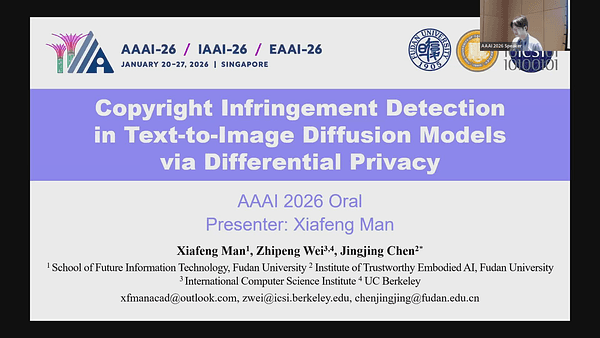
Copyright Infringement Detection in Text-to-Image Diffusion Models via Differential Privacy
technical paper

Copyright Infringement Detection in Text-to-Image Diffusion Models via Differential Privacy

AAAI 2026

Jingjing Chen
Jingjing Chen and 2 other authors

22 January 2026

Stay up to date with the latest Underline news!

Select topic of interest (you can select more than one)

PRESENTATIONS

  • All Presentations
  • For Librarians
  • Resource Center
  • Free Trial
Underline Science, Inc.
1216 Broadway, 2nd Floor, New York, NY 10001, USA

© 2025 Underline - All rights reserved