AAAI 2026

January 25, 2026

Singapore, Singapore

Would you like to see your presentation here, made available to a global audience of researchers?
Add your own presentation or have us affordably record your next conference.

Graph Neural Networks (GNNs) excel at modeling graph data but often amplify biases tied to sensitive attributes like gender and race. Existing causality-based methods use isolated interventions on graph topology or features, yet struggle to produce representations that balance predictive power with fairness. This leads to two issues: (1) weak predictive power, where representations miss critical task-relevant features, and (2) bias amplification, where representations encode sensitive attributes, causing unfair outcomes. To address these issues, we introduce the Probability of Necessity and Sufficiency (PNS), where necessity ensures representations capture only essential features for predictions, and sufficiency guarantees these features are adequate without relying on sensitive attributes. We propose FairSNR, a fairness-aware graph representation learning framework that introduces constraints based on the PNS. Specifically, FairSNR leverages PNS to guide the learning of fair representations from graph data. In particular, FairSNR employs an encoder to learn node representations with high PNS for downstream tasks. To compute and optimize PNS, FairSNR introduces an intervenor that learns to generate the most challenging counterfactual interventions on the representations, thereby enhancing the model’s causal stability even under worst-case scenarios. Finally, a discriminator is trained to detect and mitigate sensitive information leakage in the learned representations, effectively disentangling sensitive biases from task-relevant features. Experiments on real-world graph datasets demonstrate that FairSNR outperforms existing state-of-the-art (SOTA) methods in both fairness and utility.

Downloads

SlidesPaperTranscript English (automatic)

Next from AAAI 2026

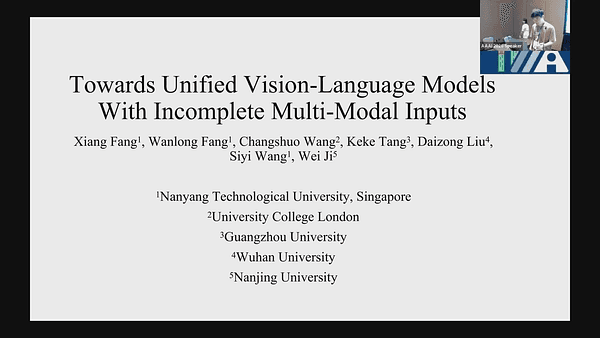
Towards Unified Vision-Language Models with Incomplete Multi-Modal Inputs
technical paper

Towards Unified Vision-Language Models with Incomplete Multi-Modal Inputs

AAAI 2026

+4Xiang Fang
Wanlong Fang and 6 other authors

25 January 2026

Stay up to date with the latest Underline news!

Select topic of interest (you can select more than one)

PRESENTATIONS

  • All Presentations
  • For Librarians
  • Resource Center
  • Free Trial
Underline Science, Inc.
1216 Broadway, 2nd Floor, New York, NY 10001, USA

© 2025 Underline - All rights reserved