AAAI 2026

January 22, 2026

Singapore, Singapore

Would you like to see your presentation here, made available to a global audience of researchers?
Add your own presentation or have us affordably record your next conference.

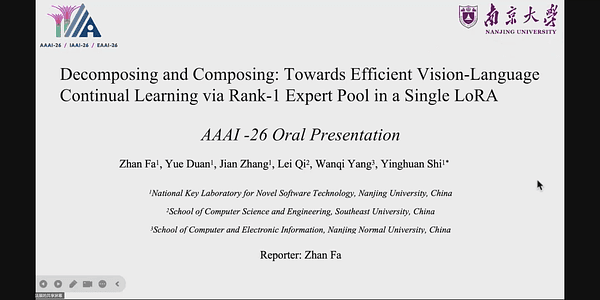
Continual Visual Instruction Tuning (CVIT) enables Multimodal Large Language Models (MLLMs) to incrementally learn new tasks over time. However, this process is challenged by catastrophic forgetting, where performance on previously learned tasks deteriorates as the model adapts to new ones. A common approach to mitigate forgetting is architecture expansion, which introduces task-specific modules to prevent interference. Yet, existing methods often expand entire layers for each task, leading to significant parameter overhead and poor scalability. To overcome these issues, we introduce LoRA in LoRA (LiLoRA), a highly efficient architecture expansion method tailored for CVIT in MLLMs. LiLoRA shares the LoRA matrix $A$ across tasks to reduce redundancy, applies an additional low-rank decomposition to matrix $B$ to minimize task-specific parameters, and incorporates a cosine-regularized stability loss to preserve consistency in shared representations over time. Extensive experiments on a diverse CVIT benchmark show that LiLoRA consistently achieves superior performance in sequential task learning while significantly improving parameter efficiency compared to existing approaches.

Downloads

SlidesPaperTranscript English (automatic)

Next from AAAI 2026

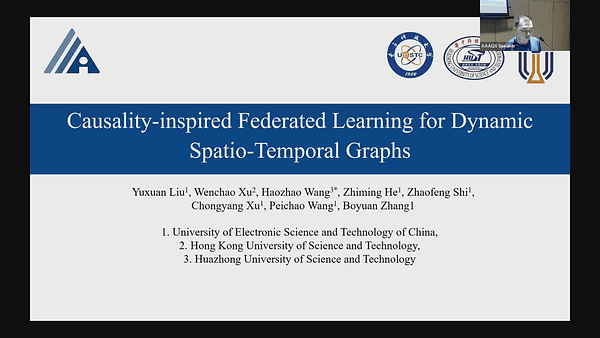
Causality-inspired Federated Learning for Dynamic Spatio-Temporal Graphs
technical paper

Causality-inspired Federated Learning for Dynamic Spatio-Temporal Graphs

AAAI 2026

+5
Zhiming He and 7 other authors

22 January 2026

Stay up to date with the latest Underline news!

Select topic of interest (you can select more than one)

PRESENTATIONS

  • All Presentations
  • For Librarians
  • Resource Center
  • Free Trial
Underline Science, Inc.
1216 Broadway, 2nd Floor, New York, NY 10001, USA

© 2025 Underline - All rights reserved