AAAI 2026

January 25, 2026

Singapore, Singapore

Would you like to see your presentation here, made available to a global audience of researchers?
Add your own presentation or have us affordably record your next conference.

Neural networks are a powerful tool for learning patterns from data. However, they do not respect known scientific laws, nor can they reveal novel scientific insights due to their black-box nature. In contrast, scientific reasoning distills biological or physical principles from observations and controlled experiments, and quantitatively interprets them with process-based models made of mathematical equations. Yet, process-based models rely on numerous free parameters that must be set in an ad-hoc manner, and thus often fit observations poorly in cross-scale predictions. While prior work has embedded process-based models in conventional neural networks, discovering interpretable relationships between parameters in process-based models and input features is still a grand challenge for scientific discovery. We thus propose Scientifically-Interpretable Reasoning Network (ScIReN), a fully-transparent framework that combines interpretable neural and process-based reasoning. An interpretable encoder predicts scientifically-meaningful latent parameters, which are then passed through a differentiable process-based decoder to predict labeled output variables. ScIReN leverages Kolmogorov-Arnold networks (KAN) to ensure the encoder is fully interpretable and reveals relationships between input features and latent parameters; it uses smoothness penalties to balance expressivity and simplicity. ScIReN also uses a novel hard-sigmoid constraint layer to restrict latent parameters to meaningful ranges defined by scientific prior knowledge, further enhancing its interpretability. While the embedded process-based model enforces established scientific knowledge, the KAN-based encoder reveals new scientific mechanisms and relationships hidden in conventional black-box models. We apply ScIReN on two tasks: simulating the flow of organic carbon through soils, and modeling ecosystem respiration from plants. In both tasks, ScIReN outperforms black-box networks in predictive accuracy while providing substantial scientific interpretability -- it can infer latent scientific mechanisms and their relationships with input features. These tasks are particularly important for mitigating climate change -- soils can sequester carbon from the atmosphere, but we have a very limited understanding of how carbon flows through these soils: ScIReN combines the best scientific knowledge with interpretable learning to help scientists gain insight into these intricate processes.

Downloads

SlidesPaperTranscript English (automatic)

Next from AAAI 2026

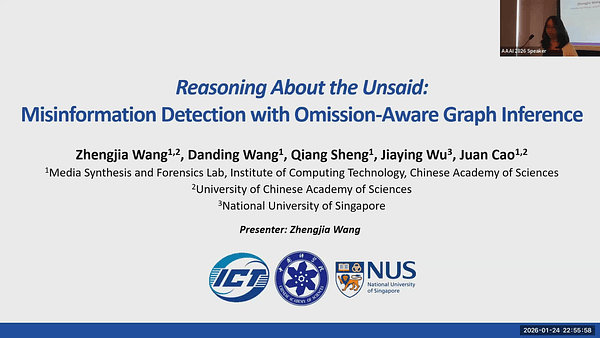
Reasoning About the Unsaid: Misinformation Detection with Omission-Aware Graph Inference
technical paper

Reasoning About the Unsaid: Misinformation Detection with Omission-Aware Graph Inference

AAAI 2026

+2Qiang ShengJuan Cao
Juan Cao and 4 other authors

25 January 2026

Stay up to date with the latest Underline news!

Select topic of interest (you can select more than one)

PRESENTATIONS

  • All Presentations
  • For Librarians
  • Resource Center
  • Free Trial
Underline Science, Inc.
1216 Broadway, 2nd Floor, New York, NY 10001, USA

© 2025 Underline - All rights reserved