AAAI 2026

January 23, 2026

Singapore, Singapore

Would you like to see your presentation here, made available to a global audience of researchers?
Add your own presentation or have us affordably record your next conference.

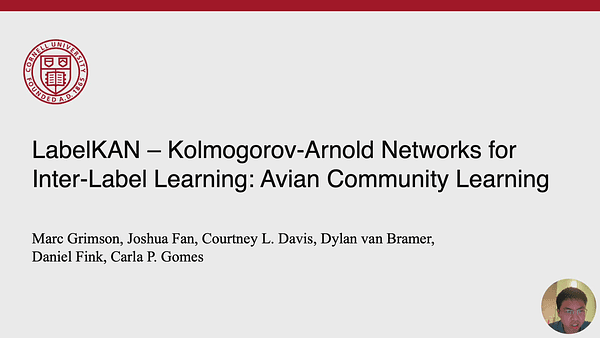
Species distribution models (SDMs), which aim to predict species occurrence based on environmental variables, are widely used to monitor and respond to biodiversity change. Recent deep learning advances for SDMs have been shown to perform well on complex and heterogeneous datasets, but their effectiveness remains limited by spatial biases in the data. In this paper, we revisit deep SDMs from a Bayesian perspective and introduce BATIS, a novel and practical framework wherein prior predictions are updated iteratively using limited observational data. Models must appropriately capture both aleatoric and epistemic uncertainty to effectively combine fine-grained local insights with broader ecological patterns. We benchmark an extensive set of uncertainty quantification approaches on a novel dataset including citizen science observations from the eBird platform. Our empirical study shows how Bayesian deep learning approaches can greatly improve the reliability of SDMs in data-scarce locations, which can contribute to ecological understanding and conservation efforts.

Downloads

SlidesPaperTranscript English (automatic)

Next from AAAI 2026

Why Do Open-Source LLMs Struggle with Data Analysis? A Systematic Empirical Study
technical paper

Why Do Open-Source LLMs Struggle with Data Analysis? A Systematic Empirical Study

AAAI 2026

+7Huajun Chen
Huajun Chen and 9 other authors

23 January 2026

Stay up to date with the latest Underline news!

Select topic of interest (you can select more than one)

PRESENTATIONS

  • All Presentations
  • For Librarians
  • Resource Center
  • Free Trial
Underline Science, Inc.
1216 Broadway, 2nd Floor, New York, NY 10001, USA

© 2025 Underline - All rights reserved