AAAI 2026

January 22, 2026

Singapore, Singapore

Would you like to see your presentation here, made available to a global audience of researchers?
Add your own presentation or have us affordably record your next conference.

Organic photovoltaic (OPV) materials offer a promising pathway for sustainable energy generation. However, their development is hindered by the challenge of identifying high-performance donor-acceptor pairs with optimal power conversion efficiencies (PCEs). Most existing design strategies focus exclusively on either the donor or the acceptor, rather than employing a unified model capable of designing both components. In this work, we introduce a dual-pronged machine learning framework for OPV discovery, integrating predictive modeling and generative molecular design. In this study, we propose the newly curated Organic Photovoltaic Donor-Acceptor Dataset (OPV$^2$D), the largest of its kind, comprising 2,000 experimentally characterized donor-acceptor pairs. This dataset serves as a comprehensive foundation for model training and evaluation. To enable accurate property prediction in organic photovoltaic (OPV) materials, we first introduce the Organic Photovoltaic Classifier (OPVC) to predict the likelihood that a given material exhibits OPV behavior. Complementing this, we develop a hierarchical graph neural network framework that integrates multi-task learning and cross-modal donor–acceptor interaction modeling. This framework includes the Molecular Orbital Energy Estimator (MOE$^2$) for predicting the highest occupied molecular orbital–lowest unoccupied molecular orbital (HOMO–LUMO) energy levels, and the Photovoltaic Performance Predictor (P$^3$) for estimating power conversion efficiency (PCE), both achieving state-of-the-art accuracy. In addition, we introduce the Material Generative Pretrained Transformer (MatGPT) to generate synthetically accessible organic semiconductors. Building on this, we propose a reinforcement learning strategy with three-objective policy optimization guides molecular generation while preserving chemical validity. By bridging molecular representation learning with device performance prediction, our framework advances computational OPV material discovery. All code and data will be open-sourced upon publication.

Downloads

SlidesPaperTranscript English (automatic)

Next from AAAI 2026

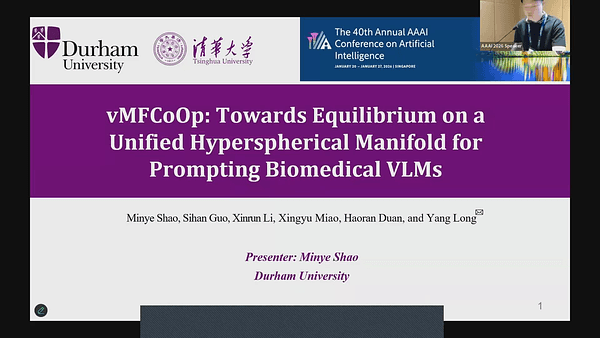
vMFCoOp: Towards Equilibrium on a Unified Hyperspherical Manifold for Prompting Biomedical VLMs
technical paper

vMFCoOp: Towards Equilibrium on a Unified Hyperspherical Manifold for Prompting Biomedical VLMs

AAAI 2026

+3
Haoran Duan and 5 other authors

22 January 2026

Stay up to date with the latest Underline news!

Select topic of interest (you can select more than one)

PRESENTATIONS

  • All Presentations
  • For Librarians
  • Resource Center
  • Free Trial
Underline Science, Inc.
1216 Broadway, 2nd Floor, New York, NY 10001, USA

© 2025 Underline - All rights reserved