Content not yet available
This lecture has no active video or poster.
Would you like to see your presentation here, made available to a global audience of researchers?
Add your own presentation or have us affordably record your next conference.
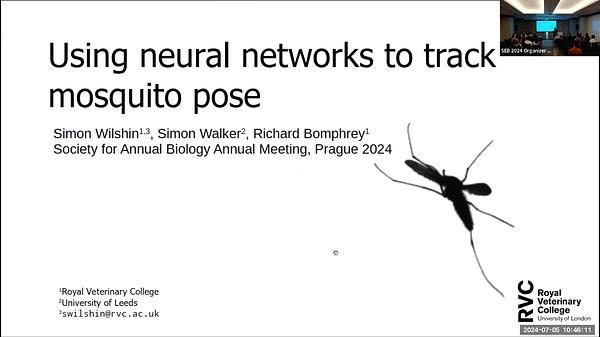
Understanding the complex host-seeking behavior of disease vectors such as mosquito is critical for predicting disease transmission and vector control. This behavior arises from a dynamic interplay between multi-modal sensory cues and internal behavioral states, a process ill-suited for traditional ODE frameworks due to its inherent stochasticity and discrete, state-based nature. We introduce the Behavioral State Attention Network (BSAN), a deep learning architecture designed to model the underlying sensorimotor computations of this behavior. BSAN utilizes a recurrent neural network (RNN) with an LSTM core to process temporal sequences, incorporating a variational encoder to capture the randomness of flight paths and a Mixture Density Network (MDN) to predict multi-modal velocity distributions. The architecture explicitly models distinct behavioral states, such as $CO_2$ plume tracking and thermal approach, through a Mixture-of-Experts (MoE) framework, and learns to interpretably integrate olfactory, thermal, and visual inputs using a cross-modal attention mechanism. The network generates realistic flight trajectories that exhibit emergent host-seeking behaviors. By providing both trajectory predictions and interpretable behavioral primitives, BSAN serves as a framework for downstream applications in landscape genomics and vector control, enabling the prediction of mosquito population connectivity through environment-specific movement kernels.