Would you like to see your presentation here, made available to a global audience of researchers?
Add your own presentation or have us affordably record your next conference.
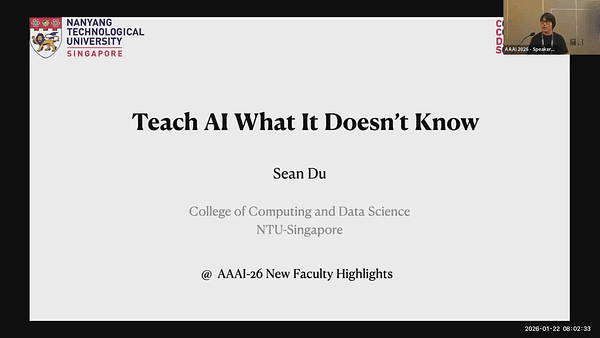
Artificial intelligence is rapidly transforming biomedical imaging, from tumor segmentation to multimodal diagnosis, but reliable deployment in hospitals remains a pressing challenge. Models often struggle with limited labeled data, fail to generalize across scanners and institutions, and lack theoretical guarantees needed for safety-critical decisions. In this talk, I will present our research on overcoming these challenges. I will discuss label-efficient and class-imbalanced learning methods that make effective use of large-scale unlabeled data, theoretical frameworks that embed statistical principles into deep learning for stability and reliability, and medical foundation models that provide universal anatomical priors with lightweight refinement for diverse clinical settings. Together, these advances move biomedical AI beyond benchmark performance toward systems that are robust, generalizable, and clinically actionable.