AAAI 2026

January 22, 2026

Singapore, Singapore

Would you like to see your presentation here, made available to a global audience of researchers?
Add your own presentation or have us affordably record your next conference.

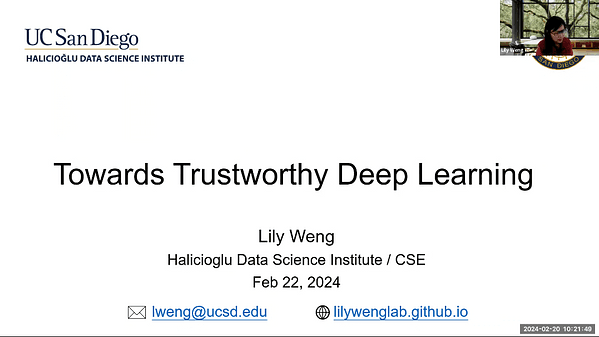
This talk surveys my research journey toward building reliable machine learning systems that behave safely and predictably in the open world. While modern machine learning models—including foundation models (FMs)—have demonstrated unprecedented capabilities, they often suffer from reliability failures under distribution shift, leading to overconfident mispredictions, hallucinated generations, or susceptibility to adversarial prompts. My research rethinks reliability not as an afterthought, but as a first-class algorithmic principle, to be optimized alongside accuracy with minimal human supervision.

The talk is organized around three key threads. To respect the allotted 20-30 minutes, the first and second parts will be briefly discussed.

  1. Unknown-Aware Learning via Outlier Synthesis. I introduce a class of learning algorithms that synthesize “virtual outliers” in representation or pixel space to explicitly teach models what they don’t know. This includes the VOS, NPOS, and Dream-OOD frameworks, which shape the energy landscape around in-distribution data to avoid overconfidence on OOD.
  1. Learning in the Wild with Unlabeled Data. I present theoretical insights and practical algorithms for leveraging unlabeled in-the-wild data to improve reliability. This includes SAL framework, which uses a gradient-based spectral method to separate potential outliers, and SCONE, which handles semantic and covariate shifts via constrained optimization. These results turn unlabeled data contamination into a learning signal.
  1. Reliable Foundation Models. I explore reliability failures in LLMs and multimodal systems. I introduce HaloScope for hallucination detection via subspace separation on LLM representations, and TSV that performs LLM latent steering for improved hallucination detection. I will also briefly cover the LLM security and alignment, which includes VLMGuard for detecting malicious prompts in vision-language models and a data-centric paradigm for AI alignment through source-aware feedback cleaning.

Throughout the talk, I highlight how representation learning, data generation, and theoretical guarantees intersect to produce scalable, label-efficient reliability methods. I will also reflect on my broader vision: designing proactive and collaborative AI systems that anticipate uncertainty and support rich human-AI interaction—especially for underrepresented communities and emerging scientific domains.

This talk will be accessible to a broad AAAI audience, combining foundational algorithmic insights with real-world applications and forward-looking perspectives on the future of responsible AI.

Downloads

PaperTranscript English (automatic)

Next from AAAI 2026

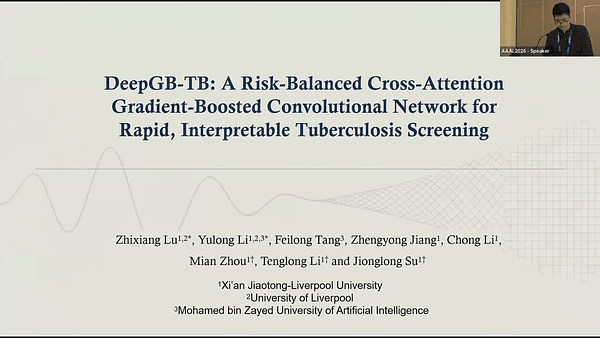
DeepGB-TB: A Risk-Balanced Cross-Attention Gradient-Boosted Convolutional Network for Rapid, Interpretable Tuberculosis Screening
technical paper

DeepGB-TB: A Risk-Balanced Cross-Attention Gradient-Boosted Convolutional Network for Rapid, Interpretable Tuberculosis Screening

AAAI 2026

+5
Zhengyong Jiang and 7 other authors

22 January 2026

Stay up to date with the latest Underline news!

Select topic of interest (you can select more than one)

PRESENTATIONS

  • All Presentations
  • For Librarians
  • Resource Center
  • Free Trial
Underline Science, Inc.
1216 Broadway, 2nd Floor, New York, NY 10001, USA

© 2025 Underline - All rights reserved