AAAI 2026

January 23, 2026

Singapore, Singapore

Would you like to see your presentation here, made available to a global audience of researchers?
Add your own presentation or have us affordably record your next conference.

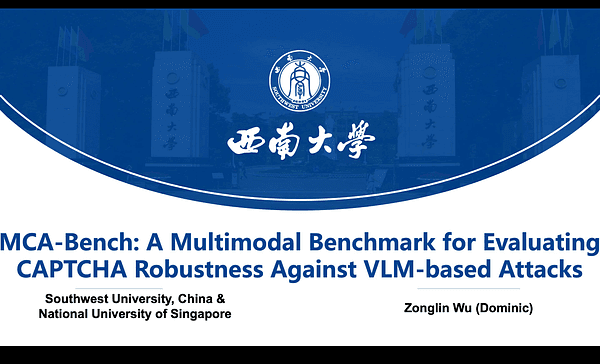
The Completely Automated Public Turing test to Tell Computers and Humans Apart (CAPTCHA) is widely deployed on the web as a security mechanism to distinguish humans from automated bots. However, their robustness is being challenged by the rapid advancements in AI, with models capable of near-human level character recognition rendering CAPTCHA obsolete. This research aims to systematically study the effect of multiple image corruptions, including elastic transformations, blur, noise, and occlusions, on human readability and automated solvers in text-based CAPTCHA recognition. We conduct experiments on multimodal large language models (MLLMs), a traditional deep learning-based optical character recognition (OCR) system, and human subjects. Using an existing CAPTCHA dataset and artificially corrupted versions, we analyze the recognition performance of AI models and humans, identifying vulnerabilities and patterns of robustness. The findings will contribute to a better understanding of CAPTCHA vulnerabilities and explore potential methods to increase the robustness of CAPTCHA in the era of advanced AI models.

Downloads

Paper

Next from AAAI 2026

Network Restoration Games with Quotas (Student Abstract)
poster

Network Restoration Games with Quotas (Student Abstract)

AAAI 2026

+1Eduard EibenArgyrios Deligkas
Philip Bogaars and 3 other authors

23 January 2026

Stay up to date with the latest Underline news!

Select topic of interest (you can select more than one)

PRESENTATIONS

  • All Presentations
  • For Librarians
  • Resource Center
  • Free Trial
Underline Science, Inc.
1216 Broadway, 2nd Floor, New York, NY 10001, USA

© 2025 Underline - All rights reserved