IJCNLP-AACL 2025

December 20, 2025

Mumbai, India

Would you like to see your presentation here, made available to a global audience of researchers?
Add your own presentation or have us affordably record your next conference.

keywords:

evaluation robustness

kv caching

majority voting

confidence stability

label-free metrics

multiple-choice evaluation

lora

selection bias

parameter-efficient fine-tuning

permutation invariance

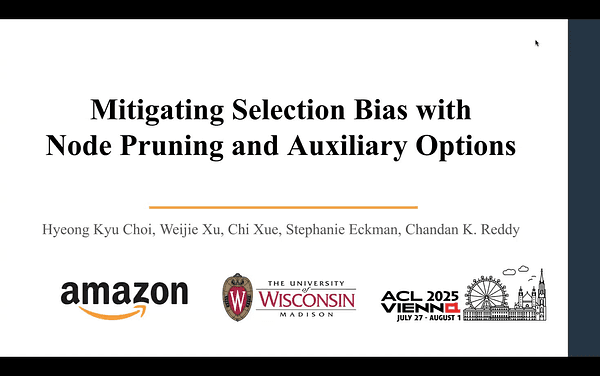
Multiple Choice Question (MCQ) answering is a widely used method for evaluating the performance of Large Language Models (LLMs). However, LLMs often exhibit selection bias in MCQ tasks, where their choices are influenced by factors like answer position or option symbols rather than the content. This bias undermines the reliability of MCQ as an evaluation framework. Most existing selection bias metrics require answer labels and measure divergences between prediction and answer distributions, but do not fully capture the consistency of a model’s predictions across different orderings of answer choices. Existing selection bias mitigation strategies have notable limitations: majority voting, though effective, is computationally prohibitive; calibration-based methods require validation sets and often fail to generalise across datasets. To address these gaps, we propose three key contributions: (1) a new unsupervised label-free \textbf{Permutation Bias Metric (PBM)} that directly quantifies inconsistencies in model predictions across answer permutations, providing a more precise measure of selection bias, (2) an efficient majority voting approach called Batch Question-Context KV caching (BaQCKV), to significantly reduce computational costs while preserving bias mitigation effectiveness, and (3) an unsupervised Low-Rank Adaptation (LoRA)-1 fine-tuning strategy based on our proposed metric and the BaQCKV that mitigates selection bias, providing a computationally efficient alternative that maintains model generalizability. Experiments across multiple MCQ benchmarks demonstrate that our approaches reduce bias, increasing consistency in accuracy while minimizing computational costs.

Downloads

SlidesTranscript English (automatic)

Next from IJCNLP-AACL 2025

Consistency Is the Key: Detecting Hallucinations in LLM Generated Text By Checking Inconsistencies About Key Facts
poster

Consistency Is the Key: Detecting Hallucinations in LLM Generated Text By Checking Inconsistencies About Key Facts

IJCNLP-AACL 2025

+1
Sumit Bhatia and 3 other authors

20 December 2025

Stay up to date with the latest Underline news!

Select topic of interest (you can select more than one)

PRESENTATIONS

  • All Presentations
  • For Librarians
  • Resource Center
  • Free Trial
Underline Science, Inc.
1216 Broadway, 2nd Floor, New York, NY 10001, USA

© 2025 Underline - All rights reserved