EMNLP 2025

November 09, 2025

Suzhou, China

Would you like to see your presentation here, made available to a global audience of researchers?
Add your own presentation or have us affordably record your next conference.

How do Large Language Models understand moral dimensions compared to humans?

This first comprehensive large-scale Bayesian evaluation of leading language models provides the answer. In contrast to prior approaches based on deterministic ground truth (obtained via majority or inclusion consensus), we obtain the labels by modelling annotators' disagreement to capture both aleatoric uncertainty (inherent human disagreement) and epistemic uncertainty (model domain sensitivity).

We evaluated Claude Sonnet 4, DeepSeek-V3, and Llama 4 Maverick across 250K+ annotations from nearly 700 annotators in 100K+ texts spanning social networks, news, and discussion forums. Our GPU-optimized Bayesian framework processed 1M+ model queries, revealing that AI models generally rank among the top 25\% of annotators in terms of balanced accuracy, substantially better than average humans.

Importantly, we find that AI produces far fewer false negatives than humans, highlighting their sensitive moral detection capabilities.

Downloads

SlidesPaperTranscript English (automatic)

Next from EMNLP 2025

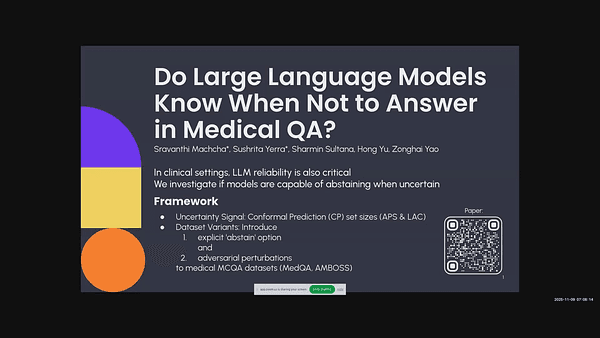
Do Large Language Models Know When Not to Answer in Medical QA?
workshop paper

Do Large Language Models Know When Not to Answer in Medical QA?

EMNLP 2025

09 November 2025

Stay up to date with the latest Underline news!

Select topic of interest (you can select more than one)

PRESENTATIONS

  • All Presentations
  • For Librarians
  • Resource Center
  • Free Trial
Underline Science, Inc.
1216 Broadway, 2nd Floor, New York, NY 10001, USA

© 2026 Underline - All rights reserved