EMNLP 2025

November 08, 2025

Suzhou, China

Would you like to see your presentation here, made available to a global audience of researchers?
Add your own presentation or have us affordably record your next conference.

The morphological structure of Semitic languages, such as Arabic, is based on non-concatenative roots and templates. This complex word structure used by humans is obscured to neural models that employ traditional tokenization algorithms. In this work, we present and evaluate Semitic Root Encoding (SRE), a tokenization method that represents both concatenative and non-concatenative structures in Semitic words with sequences of root, template stem, and BPE tokens. We apply the method to neural machine translation (NMT) and find that SRE tokenization yields an average increase of 1.15 BLEU over the baseline. We additionally compare the performance of SRE to tokenization based on non-linguistic root and template structures and tokenization based on stems, providing evidence that NMT models are capable of leveraging tokens based on non-concatenative Semitic morphology.

Downloads

SlidesPaperTranscript English (automatic)

Next from EMNLP 2025

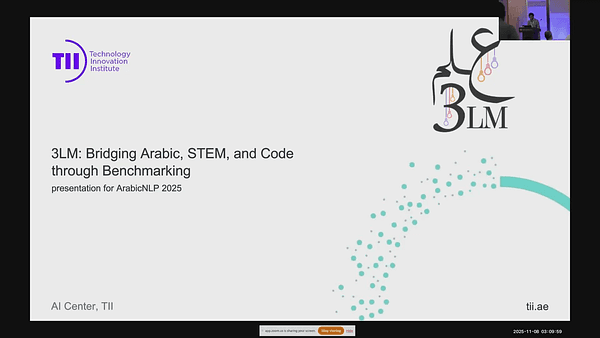
3LM: Bridging Arabic, STEM, and Code through Benchmarking
workshop paper

3LM: Bridging Arabic, STEM, and Code through Benchmarking

EMNLP 2025

+5
Leen AlQadi and 7 other authors

08 November 2025

Stay up to date with the latest Underline news!

Select topic of interest (you can select more than one)

PRESENTATIONS

  • All Presentations
  • For Librarians
  • Resource Center
  • Free Trial
Underline Science, Inc.
1216 Broadway, 2nd Floor, New York, NY 10001, USA

© 2026 Underline - All rights reserved