Would you like to see your presentation here, made available to a global audience of researchers?
Add your own presentation or have us affordably record your next conference.
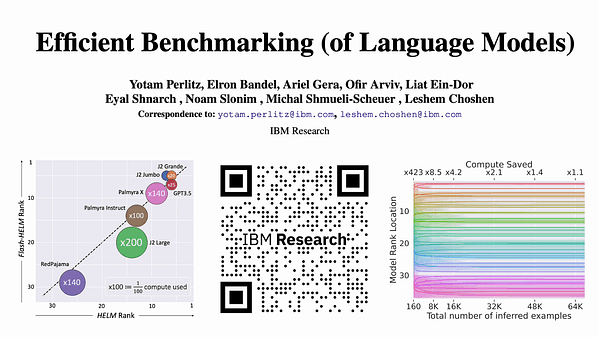
Modern language models are evaluated on large benchmarks. Given how many different numbers these evaluations output, making sense of them for model selection can be difficult. We take a closer look at this using a model-centric lens and look at the evaluation numbers themselves. In this work, we analyze benchmarks in three stages: dataset & model comparison, representative set identification, and performance prediction. Since datasets and models relate strongly to one another, we develop an algorithm to identify a representative set of datasets that covers a benchmark using the raw evaluation scores alone. Using our algorithm, we find that with 5.9% (1/17), 1.7% (1/58), and 16.2% (12/74) of the datasets for HELM, MMLU, and BigBenchLite respectively, we achieve coverage levels of at least 95%. Additionally, using just these representative subsets, we can both preserve model ranks and predict performance on a held-out set of models with near zero mean-squared error. Taken together, our analysis can help model developers improve efficiency and allow dataset creators validate whether their newly created dataset differs from existing datasets in the benchmark.