EMNLP 2025

November 05, 2025

Suzhou, China

Would you like to see your presentation here, made available to a global audience of researchers?
Add your own presentation or have us affordably record your next conference.

keywords:

morphological analysis

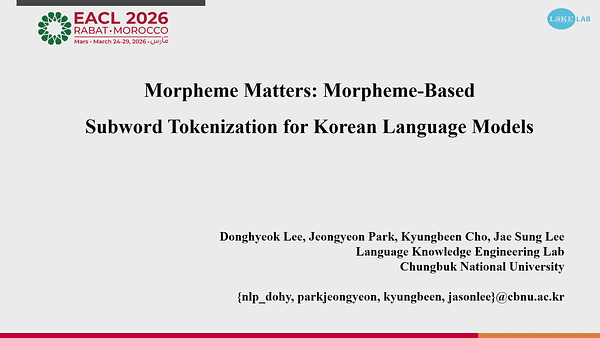
We investigate whether Transformer-based language models, trained solely on Hangul text, can learn the semantics of Sino-Korean (SK) morphemes, which are fundamental to Korean vocabulary. Using BERT_BASE and fastText, we conduct controlled experiments with target words and their “real” vs. “fake” neighbors—pairs that share a Hangul syllable representing the same SK morpheme vs. those that share only the Hangul syllable. Our results show that while both models—especially BERT—distinguish real and fake pairs to some extent, their performance is primarily driven by the frequency of each experimental word rather than a true understanding of SK morphemes. These findings highlight the limits of distributional learning for morpheme-level understanding and emphasize the need for explicit morphological modeling or Hanja-aware strategies to improve semantic representation in Korean language models.

Downloads

SlidesPaperTranscript English (automatic)

Next from EMNLP 2025

MOLE: Metadata Extraction and Validation in Scientific Papers Using LLMs
poster

MOLE: Metadata Extraction and Validation in Scientific Papers Using LLMs

EMNLP 2025

Zaid Alyafeai and 2 other authors

05 November 2025

Stay up to date with the latest Underline news!

Select topic of interest (you can select more than one)

PRESENTATIONS

  • All Presentations
  • For Librarians
  • Resource Center
  • Free Trial
Underline Science, Inc.
1216 Broadway, 2nd Floor, New York, NY 10001, USA

© 2025 Underline - All rights reserved