EMNLP 2025

November 05, 2025

Suzhou, China

Would you like to see your presentation here, made available to a global audience of researchers?
Add your own presentation or have us affordably record your next conference.

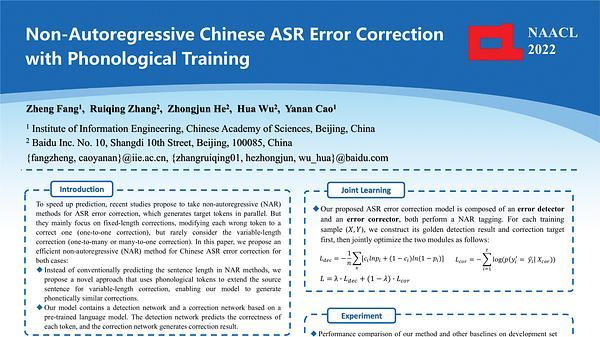
Automatic Speech Recognition (ASR) is a fundamental and important task in the field of speech and natural language processing. It is an inherent building block in many applications such as voice assistant, speech translation, etc. Despite the advancement of ASR technologies in recent years, it is still inevitable for modern ASR systems to have a substantial number of erroneous recognition due to environmental noise, ambiguity, etc. Therefore, the error correction in ASR is crucial.

Motivated by this, this paper studies ASR error correction in the Chinese language, which is one of the most popular languages and enjoys a large number of users in the world. We first create a benchmark dataset named \emph{ASR-EC} that contains a wide spectrum of ASR errors generated by industry-grade ASR systems. To the best of our knowledge, it is the first Chinese ASR error correction benchmark. Then, inspired by the recent advances in \emph{large language models (LLMs)}, we investigate how to harness the power of LLMs to correct ASR errors. We apply LLMs to ASR error correction in three paradigms. The first paradigm is prompting, which is further categorized as zero-shot, few-shot, and multi-step. The second paradigm is finetuning, which finetunes LLMs with ASR error correction data. The third paradigm is multi-modal augmentation, which collectively utilizes the audio and ASR transcripts for error correction. Extensive experiments reveal that prompting is not effective for ASR error correction. Finetuning is effective only for a portion of LLMs. Multi-modal augmentation is the most effective method for error correction and achieves state-of-the-art performance.

Downloads

Paper

Next from EMNLP 2025

AI Knowledge Assist: An Automated Approach for the Creation of Knowledge Bases for Conversational AI Agents
poster

AI Knowledge Assist: An Automated Approach for the Creation of Knowledge Bases for Conversational AI Agents

EMNLP 2025

+2Xue-Yong Fu
Cheng Chen and 4 other authors

05 November 2025

Stay up to date with the latest Underline news!

Select topic of interest (you can select more than one)

PRESENTATIONS

  • All Presentations
  • For Librarians
  • Resource Center
  • Free Trial
Underline Science, Inc.
1216 Broadway, 2nd Floor, New York, NY 10001, USA

© 2025 Underline - All rights reserved