EMNLP 2025

November 05, 2025

Suzhou, China

Would you like to see your presentation here, made available to a global audience of researchers?
Add your own presentation or have us affordably record your next conference.

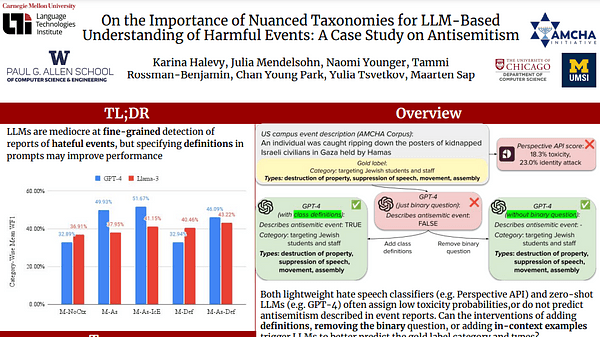
Detecting hateful content is a challenging and important problem. Automated tools, like machine‑learning models, can help, but they require continuous training to adapt to the ever-changing landscape of social media. In this work, we evaluate eight open-source LLMs' capability to detect antisemitic content, specifically leveraging in-context definition as a policy guideline. We explore various prompting techniques and design a new CoT-like prompt, Guided-CoT. Guided‑CoT handles the in-context policy well, increasing performance across all evaluated models, regardless of decoding configuration, model sizes, or reasoning capability. Notably, Llama 3.1 70B outperforms fine-tuned GPT-3.5. Additionally, we introduce metrics to quantify semantic divergence in model-generated rationales, revealing notable differences and paradoxical behaviors among LLMs. Our experiments highlight the differences observed across LLMs' utility, explainability, and reliability.

Downloads

SlidesPaperTranscript English (automatic)

Next from EMNLP 2025

Decode, move and speak! Self-supervised learning of speech units, gestures and sounds relationships using vocal imitation
poster

Decode, move and speak! Self-supervised learning of speech units, gestures and sounds relationships using vocal imitation

EMNLP 2025

+1Marvin LavechinThomas Hueber
Marc-Antoine Georges and 3 other authors

05 November 2025

Stay up to date with the latest Underline news!

Select topic of interest (you can select more than one)

PRESENTATIONS

  • All Presentations
  • For Librarians
  • Resource Center
  • Free Trial
Underline Science, Inc.
1216 Broadway, 2nd Floor, New York, NY 10001, USA

© 2025 Underline - All rights reserved