Would you like to see your presentation here, made available to a global audience of researchers?
Add your own presentation or have us affordably record your next conference.
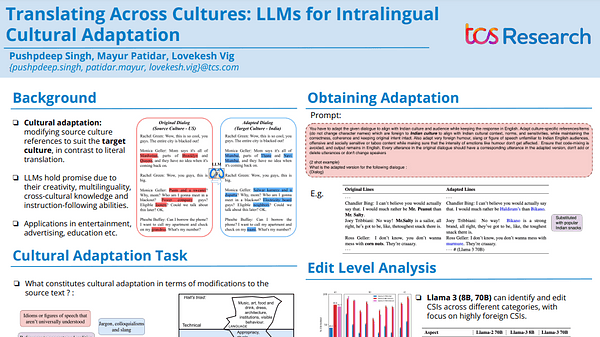
Large language models (LLMs) are used in various applications. However, despite its wide capabilities, it is shown to lack cultural alignment \citep{ryan-etal-2024-unintended, alkhamissi-etal-2024-investigating} and produce biased generations \cite{naous-etal-2024-beer} due to a lack of cultural knowledge and competence. Evaluation of LLMs for cultural awareness and alignment is particularly challenging due to the lack of proper evaluation metrics and the unavailability of culturally grounded datasets representing the vast complexity of cultures at the regional and sub-regional levels. Existing datasets for culture-specific items (CSIs) focus primarily on concepts at regional levels and contain several inconsistencies regarding the cultural attribution of items. To address this issue, we created a novel CSI dataset for Indian culture, belonging to 17 cultural facets. The dataset\footnote{Our dataset, code, and LLMs generations will be made available upon acceptance of the work.} comprises sim8k cultural concepts from 36 sub-regions. To measure cultural competence, we evaluate the adaptation of LLMs to cultural text using the created CSIs, LLM-based, and human evaluations. Also, we perform quantitative analysis demonstrating selective sub-regional coverage and surface-level adaptations across all considered LLMs.