EMNLP 2025

November 07, 2025

Suzhou, China

Would you like to see your presentation here, made available to a global audience of researchers?
Add your own presentation or have us affordably record your next conference.

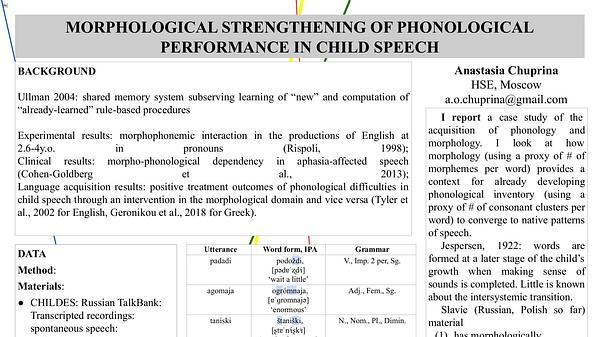
Self-supervised speech models can be trained to efficiently recognize spoken words in naturalistic, noisy environments. However, we do not understand the types of linguistic representations these models use to accomplish this task. To address this question, we study how S3M variants optimized for word recognition represent phonological and morphological phenomena in frequent English noun and verb inflections. We find that their representations exhibit a global linear geometry which can be used to link English nouns and verbs to their regular inflected forms. This geometric structure does not directly track phonological or morphological units. Instead, it tracks the regular distributional relationships linking many word pairs in the English lexicon—often, but not always, due to morphological inflection. These findings point to candidate representational strategies that may support human spoken word recognition, challenging the presumed necessity of distinct linguistic representations of phonology and morphology.

Downloads

SlidesPaperTranscript English (automatic)

Next from EMNLP 2025

Improving Large Language Model Safety with Contrastive Representation Learning
poster

Improving Large Language Model Safety with Contrastive Representation Learning

EMNLP 2025

+1Bernhard SchölkopfMrinmaya SachanZhijing Jin
Zhijing Jin and 3 other authors

07 November 2025

Stay up to date with the latest Underline news!

Select topic of interest (you can select more than one)

PRESENTATIONS

  • All Presentations
  • For Librarians
  • Resource Center
  • Free Trial
Underline Science, Inc.
1216 Broadway, 2nd Floor, New York, NY 10001, USA

© 2025 Underline - All rights reserved