Would you like to see your presentation here, made available to a global audience of researchers?
Add your own presentation or have us affordably record your next conference.
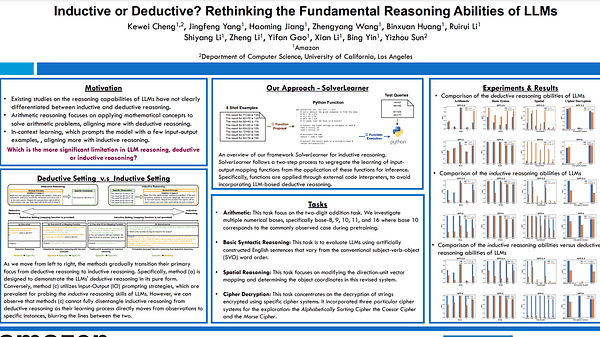
Modern large language models (LLMs) employ diverse logical inference mechanisms for reasoning, making the strategic optimization of these approaches critical for advancing their capabilities. This paper systematically investigate the comparative dynamics of inductive (System 1) versus abductive/deductive (System 2) inference in LLMs. We utilize a controlled analogical reasoning environment, varying modality (textual, visual, symbolic), difficulty, and task format (MCQ / free-text). Our analysis reveals System 2 pipelines generally excel, particularly in visual/symbolic modalities and harder tasks, while System 1 is competitive for textual and easier problems. Crucially, task format significantly influences their relative advantage, with System 1 sometimes outperforming System 2 in free-text rule-execution. These core findings generalize to broader in-context learning. Furthermore, we demonstrate that advanced System 2 strategies like hypothesis selection and iterative refinement can substantially scale LLM reasoning. This study offers foundational insights and actionable guidelines for strategically deploying logical inference to enhance LLM reasoning.