Would you like to see your presentation here, made available to a global audience of researchers?
Add your own presentation or have us affordably record your next conference.
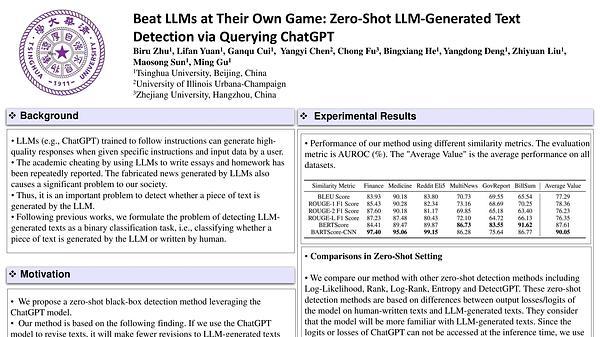
Large language models (LLMs) can generate fluent text, raising concerns about misuse in online comments and academic writing, leading to issues like corpus pollution and copyright infringement. Existing LLM text detection methods often rely on features from the logit distribution of the input text. However, the distinction between the LLM-generated and human-written texts may rely on only a few tokens due to the short length or insufficient information in some texts, leading to minimal and hard-to-detect differences in logit distributions. To address this, we propose HALO, an LLM-based detection method that leverages external text corpora to evaluate the difference of logit distribution of input text under retrieved human-written and LLM-rewritten contexts. We find that LLM-generated texts show significantly greater consistency across varied contexts than human-written texts. HALO also complements basic detection features and can be served as a plug-and-play module to enhance existing detection methods. Extensive experiments on five public datasets with three widely-used source LLMs show that our proposed detection method achieves state-of-the-art performance in AUROC, both in cross-domain and domain-specific scenarios.