EMNLP 2025

November 06, 2025

Suzhou, China

Would you like to see your presentation here, made available to a global audience of researchers?
Add your own presentation or have us affordably record your next conference.

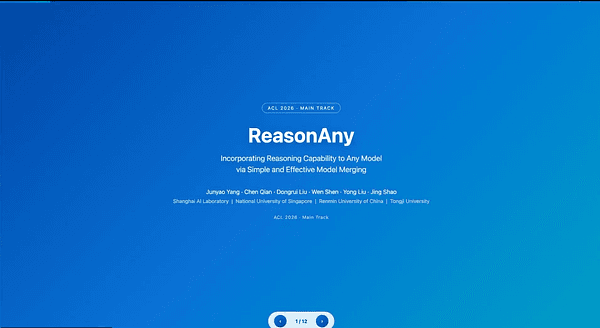
Large Language Models (LLMs) rely heavily on large-scale reasoning data, but as such data becomes increasingly scarce, model self-improvement offers a promising alternative. However, this process can lead to model collapse, as the model’s output becomes overly deterministic with reduced diversity. In this work, we identify a new risk beyond model collapse, which we term the Superficial Self-Improved Reasoners phenomenon. This phenomenon indicates that while self-improvement enhances in-domain (ID) reasoning accuracy, it degrades the model’s generalized reasoning capability on out-of-domain (OOD) datasets, as the model tends to memorize the training data. Our analyses of layer importance and parameter changes reveal that reasoning-critical layers receive fewer updates compared to less relevant layers during self-improvement. To address this, we propose Iterative Model Merging (IMM), which balances reasoning improvements and generalization by merging the weights of the original and self-improved models. IMM effectively mitigates model collapse and improves generalized reasoning capability.

Downloads

SlidesPaperTranscript English (automatic)

Next from EMNLP 2025

VideoEraser: Concept Erasure in Text-to-Video Diffusion Models
poster

VideoEraser: Concept Erasure in Text-to-Video Diffusion Models

EMNLP 2025

+5
Zhi Chen and 7 other authors

06 November 2025

Stay up to date with the latest Underline news!

Select topic of interest (you can select more than one)

PRESENTATIONS

  • All Presentations
  • For Librarians
  • Resource Center
  • Free Trial
Underline Science, Inc.
1216 Broadway, 2nd Floor, New York, NY 10001, USA

© 2025 Underline - All rights reserved