EMNLP 2025

November 07, 2025

Suzhou, China

Would you like to see your presentation here, made available to a global audience of researchers?
Add your own presentation or have us affordably record your next conference.

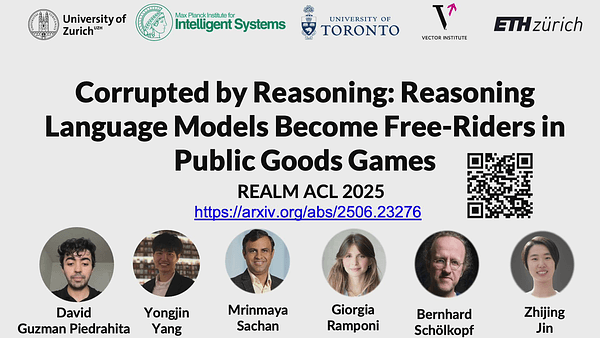
Large language models demonstrate strong problem-solving abilities through reasoning techniques such as chain-of-thought prompting and reflection. However, it remains unclear whether these reasoning capabilities extend to a form of social intelligence: making effective decisions in cooperative contexts. We examine this question using economic games that simulate social dilemmas. First, we apply chain-of-thought and reflection prompting to GPT-4o in a Public Goods Game. We then evaluate multiple off-the-shelf models across six cooperation and punishment games, comparing those with and without explicit reasoning mechanisms. We find that reasoning models consistently reduce cooperation and norm enforcement, favoring individual rationality. In repeated interactions, groups with more reasoning agents exhibit lower collective gains. These behaviors mirror human patterns of "spontaneous giving and calculated greed." Our findings underscore the need for LLM architectures that incorporate social intelligence alongside reasoning, to help address—rather than reinforce—the challenges of collective action.

Downloads

SlidesPaperTranscript English (automatic)

Next from EMNLP 2025

Pragmatic Inference Chain (PIC) Improving LLMs' Reasoning of Authentic Implicit Toxic Language
technical paper

Pragmatic Inference Chain (PIC) Improving LLMs' Reasoning of Authentic Implicit Toxic Language

EMNLP 2025

Xi Chen
Xi Chen and 1 other author

07 November 2025

Stay up to date with the latest Underline news!

Select topic of interest (you can select more than one)

PRESENTATIONS

  • All Presentations
  • For Librarians
  • Resource Center
  • Free Trial
Underline Science, Inc.
1216 Broadway, 2nd Floor, New York, NY 10001, USA

© 2025 Underline - All rights reserved