EMNLP 2025

November 05, 2025

Suzhou, China

Would you like to see your presentation here, made available to a global audience of researchers?
Add your own presentation or have us affordably record your next conference.

Existing research in multi-hop questions has identified two reasoning modes: latent reasoning and factual shortcuts, but has not deeply investigated how these modes differ during inference. This impacts both model generalization ability and downstream reasoning tasks. In this work, we systematically examine these distinctions and propose a simple and efficient classification metric, Attribute Rate Ratio (ARR). First, we construct specialized datasets corresponding to the two reasoning modes based on our proposed criteria. Then, using reverse engineering methods, including attention knockout and logit lens techniques, we reveal that subject representations differ significantly across modes: latent reasoning encodes bridge-related information for final answer extraction, while factual shortcuts bypass intermediate reasoning and resemble single-hop factual queries. Finally, our proposed ARR achieves around 90% accuracy on our datasets and demonstrates effectiveness in RAG conflict scenarios, showing that model behavior under conflicting prompts is closely tied to its underlying reasoning mode. Our findings and proposed metric have significant potential for advancing LLM development and applications.

Downloads

SlidesPaperTranscript English (automatic)

Next from EMNLP 2025

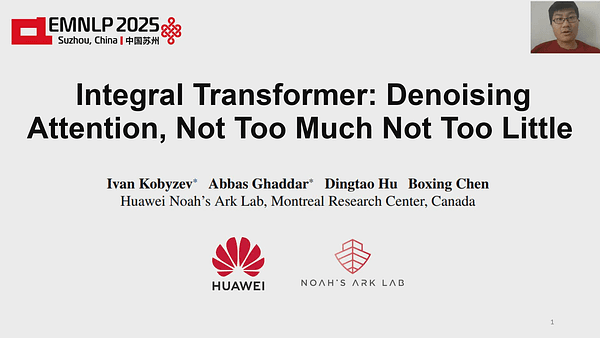
Integral Transformer: Denoising Attention, Not Too Much Not Too Little
technical paper

Integral Transformer: Denoising Attention, Not Too Much Not Too Little

EMNLP 2025

+1
Boxing Chen and 3 other authors

05 November 2025

Stay up to date with the latest Underline news!

Select topic of interest (you can select more than one)

PRESENTATIONS

  • All Presentations
  • For Librarians
  • Resource Center
  • Free Trial
Underline Science, Inc.
1216 Broadway, 2nd Floor, New York, NY 10001, USA

© 2025 Underline - All rights reserved