EMNLP 2025

November 07, 2025

Suzhou, China

Would you like to see your presentation here, made available to a global audience of researchers?
Add your own presentation or have us affordably record your next conference.

There are more than 7,000 languages around the world, and current Large Language Models (LLMs) only support hundreds of languages. Dictionary-based prompting methods are quite good for this purpose, but most methods use all the available dictionaries, which could be expensive. Instead, it will be flexible to have a trade-off between token consumption and translation performance. This paper proposes a novel task called \textbf{A}utomatic \textbf{D}ictionary \textbf{S}election (\textbf{ADS}). The goal of the task is to automatically select which dictionary to use to enhance translation. We propose a novel and effective method which we call \textbf{S}elect \textbf{Lo}w-frequency \textbf{W}ords! (\textbf{SLoW}) which selects those dictionaries that have a lower frequency. Our methods have unique advantages. First, there is no need for access to the training data for frequency estimation (which is usually unavailable), which will be explained in the remaining of this paper. Second, it inherits the advantage of dictionary-based methods, where no additional tuning is required on LLMs. Experimental results on 100 languages from FLORES indicate that SLoW surpasses strong baselines, and it can obviously save token usage, with many languages even surpassing the translation performance of the full dictionary baseline.\footnote{A shocking fact is that there is no need to use the actual training data (often unobtainable) for frequency estimation, and an estimation frequency obtained using public resources is still apparently effective in improving translation with ChatGPT and Llama.}\footnote{Code and data available upon publication.}

Downloads

SlidesPaperTranscript English (automatic)

Next from EMNLP 2025

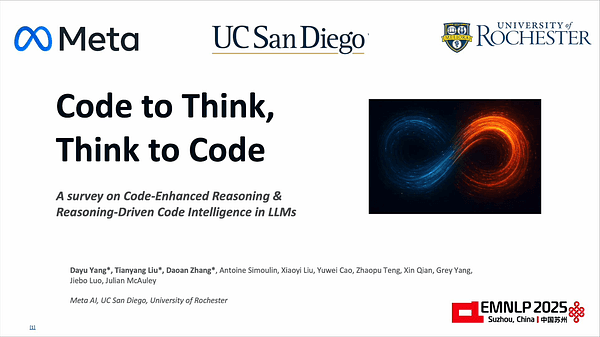
Code to Think, Think to Code: A Survey on Code-Enhanced Reasoning and Reasoning-Driven Code Intelligence in LLMs
technical paper

Code to Think, Think to Code: A Survey on Code-Enhanced Reasoning and Reasoning-Driven Code Intelligence in LLMs

EMNLP 2025

+8Yuwei Cao
Yuwei Cao and 10 other authors

07 November 2025

Stay up to date with the latest Underline news!

Select topic of interest (you can select more than one)

PRESENTATIONS

  • All Presentations
  • For Librarians
  • Resource Center
  • Free Trial
Underline Science, Inc.
1216 Broadway, 2nd Floor, New York, NY 10001, USA

© 2025 Underline - All rights reserved