2025 AMA Research Challenge – Member Premier Access

October 22, 2025

Virtual only, United States

Would you like to see your presentation here, made available to a global audience of researchers?
Add your own presentation or have us affordably record your next conference.

Objective

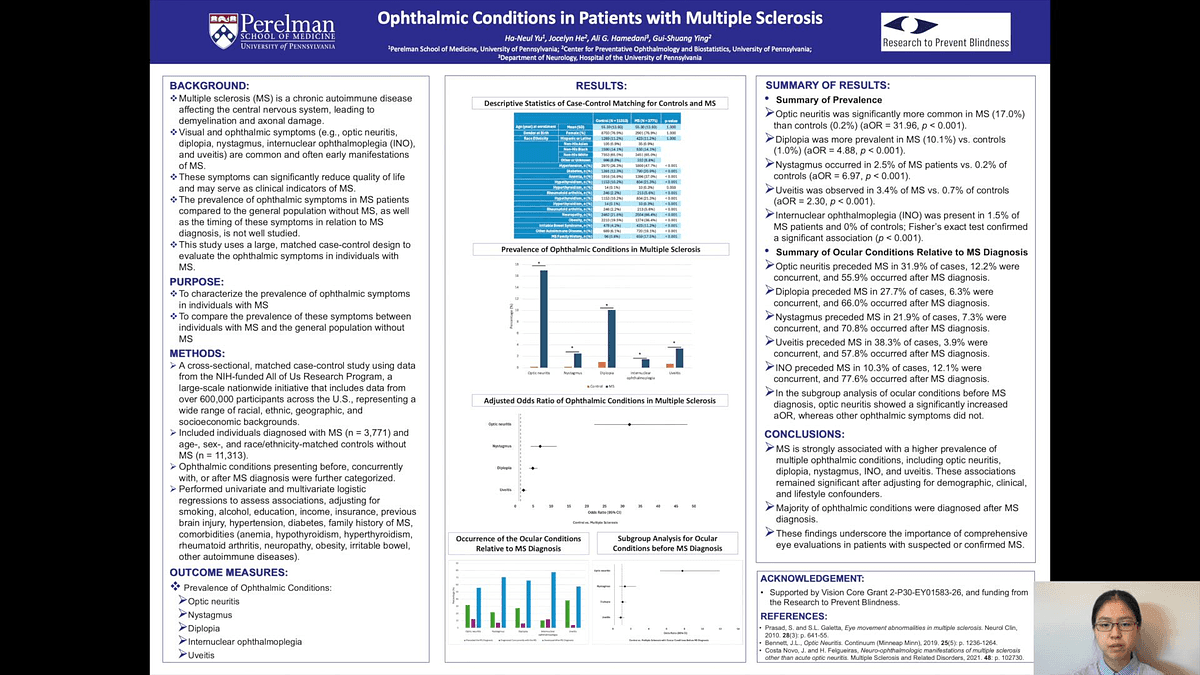
Multiple sclerosis (MS) is a chronic autoimmune disorder of the central nervous system frequently associated with visual symptoms. This study aimed to characterize the prevalence of ophthalmic conditions in individuals with MS and compare it to matched controls without MS.

Methods

A matched case-control, cross-sectional study was conducted using data from the All of Us Research Program, a large, nationwide NIH-funded initiative. Individuals with MS (n = 3771) were matched 1:3 to controls without MS (n = 11,313) by age, sex, and race/ethnicity. Four ophthalmic conditions—optic neuritis, diplopia, nystagmus, and uveitis—were examined. Based on electronic health records, diagnosis dates were categorized into ophthalmic conditions occurring before, concurrently with, or after the MS diagnosis. Prevalence rates of ophthalmic conditions in individuals with MS were compared to those of matched controls, through univariate and multivariate logistic regression models, adjusting for sociodemographic factors, lifestyle variables, prior brain injury, family history of MS, and comorbidities.

Results

All ophthalmic conditions were significantly more prevalent in individuals with MS than controls. Optic neuritis was most common (17.0 % vs. 0.2 %; adjusted odds ratio (aOR) = 31.96; 95 % CI: 22.09–48.20; p < 0.001), followed by diplopia (10.1 % vs. 1.0 %; aOR = 4.88; 95 % CI: 3.87–6.19; p < 0.001), uveitis (3.4 % vs. 0.7 %; aOR = 2.30; 95 % CI: 1.66–3.19; p < 0.001), and nystagmus (2.5 % vs. 0.2 %; aOR = 6.97; 95 % CI: 4.31–11.62; p < 0.001). The temporal analysis revealed that some cases of optic neuritis (31.9 %), nystagmus (21.9 %), diplopia (27.7 %), and uveitis (38.3 %) preceded MS diagnosis. Optic neuritis prior to MS was significantly more prevalent than matched controls (5.4 % vs. 0.2 %; aOR = 7.77; 95 % CI: 5.25, 11.94; p < 0.001).

Conclusion

This study presents population-based data on the frequency of ophthalmic disease in patients with MS. Ophthalmic conditions, particularly optic neuritis, were significantly more common in individuals with MS compared to matched controls. The study also characterizes the prevalence of uveitis, which is relatively rarer than other ophthalmic conditions in the MS population, yet still more common than matched controls. Some visual conditions occurred before the clinical diagnosis of MS, some concurrently, and others afterward. These findings underscore the importance of recognizing visual disturbances in the diagnosis and management of MS and highlight the need for close collaboration between neurologists and ophthalmologists in the care of patients with MS.

Downloads

Transcript English (automatic)

Next from 2025 AMA Research Challenge – Member Premier Access

Efficacy and Safety of Idecabtagene Vicleucel in Relapsed/Refractory Multiple Myeloma

Efficacy and Safety of Idecabtagene Vicleucel in Relapsed/Refractory Multiple Myeloma

2025 AMA Research Challenge – Member Premier Access

Selia Chowdhury

22 October 2025

Stay up to date with the latest Underline news!

Select topic of interest (you can select more than one)

PRESENTATIONS

  • All Presentations
  • For Librarians
  • Resource Center
  • Free Trial
Underline Science, Inc.
1216 Broadway, 2nd Floor, New York, NY 10001, USA

© 2025 Underline - All rights reserved