Would you like to see your presentation here, made available to a global audience of researchers?
Add your own presentation or have us affordably record your next conference.
Background
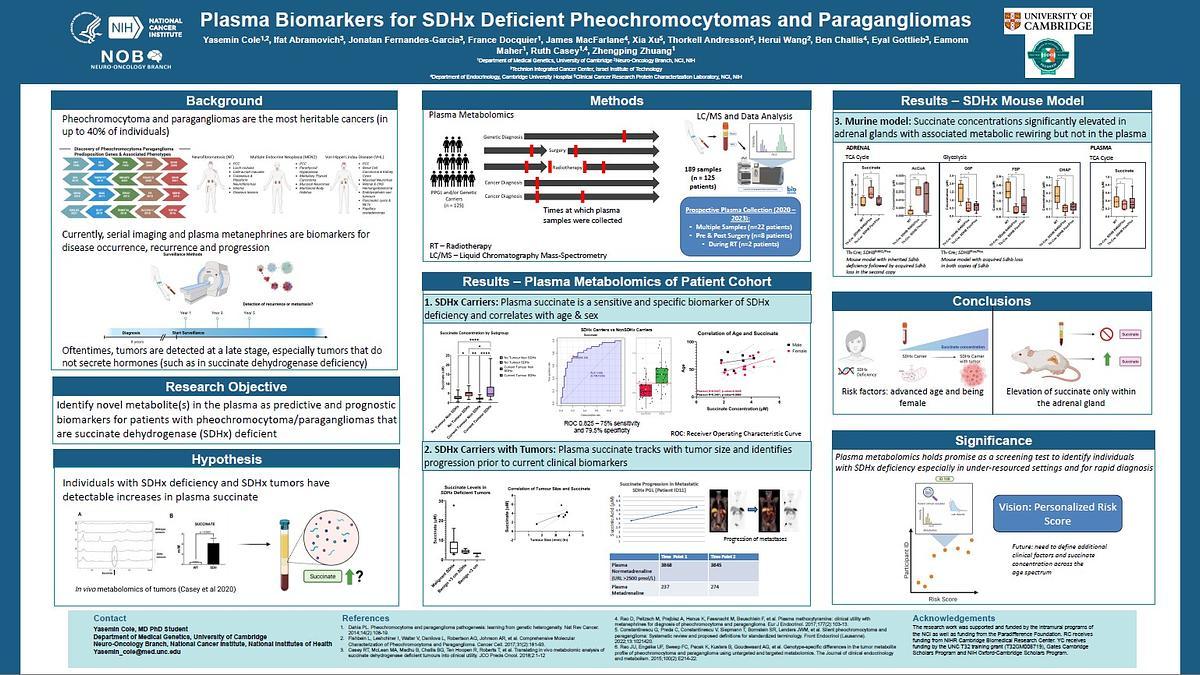
Pheochromocytomas and paragangliomas (PPGLs) are rare neural-crest derived tumors with one of the highest germline heritability rates of all neoplasias (40%) and lead to lifelong surveillance. Succinate dehydrogenase (SDHx)-deficient PPGLs are associated with an aggressive disease course, with an overall survival of 50% at 5 years for individuals with metastatic disease. Predicting primary tumor development or metastatic disease progression throughout the life course with imaging/plasma metanephrines and histopathological scoring systems have limitations. The discovery of metabolic rewiring of SDHx deficiency at the tumor level holds promise as a non-invasive disease biomarker.
Methods
Harnessing the connection of SDHx to metabolic dysfunction, we performed prospective plasma metabolomics (liquid chromatography/mass spectrometry) on 122 well-phenotyped patients, 49.1% of whom were SDHx carriers, at one or multiple time points during a patient’s clinical journey. Concurrently, tissue (adrenal, muscle, heart, brain) and plasma metabolomics of a novel SDHx deficient murine model were utilized for validation of patient-derived biomarkers.
Results
Metabolomics of patient plasma samples revealed that succinate is a sensitive and specific biomarker of SDHx deficiency (ROC 0.825 – 75% sensitivity and 79.5% specificity), and succinate:glycine ratios improved the ROC to 0.856. With deep phenotyping, we found that age, BMI, and sex trended with succinate. Specifically, succinate levels were significantly correlated with female sex and increasing age. Of those with tumors, succinate had a ROC of 0.933, distinguishing SDHx deficient (including WT gastrointestinal stromal tumors (GISTs), which lack clinical biomarkers of disease) and proficient tumors. Five individuals with SDHx deficient tumors with multiple blood samples developed progressive disease, all of which were correspondingly reflected in succinate elevations. Succinate was not sensitive to treatment response (of both radiotherapy and surgery). Murine SDHx deficient adrenal glands had significantly elevated succinate concentrations however there were no significant changes in succinate plasma concentrations compared to WT mice.
Conclusion
These findings suggest that plasma metabolomics holds promise as a screening test, especially in resource-poor settings or when rapid clinical decision making is necessary, as genetic testing can often take weeks, if not months, in some clinical settings. Prior to clinical application, further definition of the normal distribution of succinate levels in the general population is required. The mechanism underlying the unexpected finding of elevated succinate in SDHx carriers is a focus of future research. Overall, plasma metabolomics is a novel companion diagnostic for asymptomatic SDHx carriers and individuals with SDHx deficient tumors, of not only PPGLs but also GISTs.