2025 AMA Research Challenge – Member Premier Access

October 22, 2025

Virtual only, United States

Would you like to see your presentation here, made available to a global audience of researchers?
Add your own presentation or have us affordably record your next conference.

Background

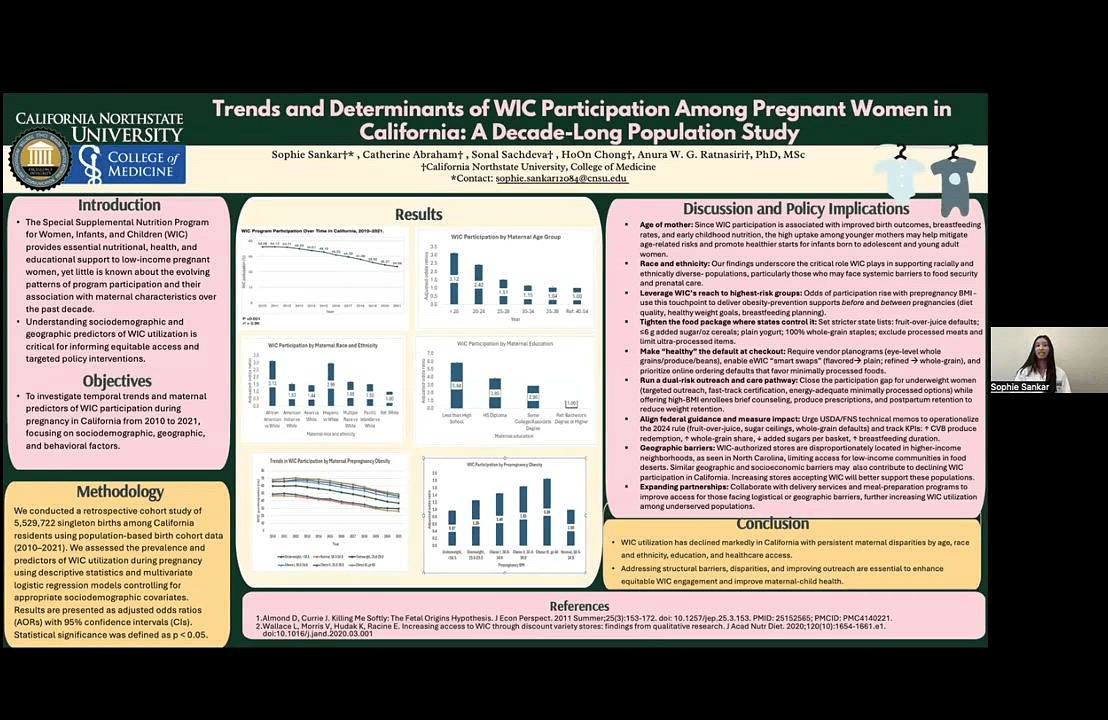
The Special Supplemental Nutrition Program for Women, Infants, and Children (WIC) provides essential nutritional, health, and educational support to low-income pregnant women; however, little is known about trends in program participation and associated maternal characteristics this past decade. We aim to investigate temporal trends and maternal predictors of WIC participation during pregnancy in California from 2010-2021, focusing on sociodemographic, geographic, and behaviors. Understanding these predictors is critical for informing equitable access and targeted policy interventions.

Methods

We conducted a retrospective cohort analysis of 5,529,722 singleton births among California residents using population-based birth cohort data from 2010 to 2021. Descriptive statistics, linear trend analyses, and multivariate logistic regression models were used to assess prevalence and predictors of WIC utilization during pregnancy. Odds ratios (ORs), 95% confidence intervals (CIs), and p-values were reported in quantified associations. Statistical significance was defined as p < 0.05.

Results

WIC participation declined significantly over the study period, from 54.1% in 2010 to 35.0% in 2021 (β=–1.83, p<.0001, R²=0.98). Multivariate analysis identified several independent predictors of WIC utilization. Compared to mothers aged 40–54 years, those under 20 had the highest odds of WIC use (OR = 3.12; 95% CI: 3.06–3.19). African American (OR = 3.126), Hispanic (OR = 2.96), and American Indian mothers (OR = 1.53) were significantly more likely to participate than White mothers. A strong inverse gradient was observed; mothers with less than high school education had nearly sixfold higher odds (OR = 5.84) than those with a bachelor’s degree or higher. Utilization was higher among foreign born mothers (OR = 1.53) and in regions such as San Joaquin Valley (OR = 2.72) and Los Angeles County (OR = 2.55) compared to Greater Bay Area. Mothers with Medi-Cal (OR=8.09), first-trimester prenatal care (OR = 1.07), higher prepregnancy BMI (e.g., OR = 1.91 for Obese III), vaginal deliveries (OR = 1.02), and maternal smoking during both trimesters (OR = 1.17) were significantly more likely to participate.

Conclusion

WIC utilization during pregnancy has declined markedly in California, despite persistent disparities by age, race/ethnicity, education, nativity, geographic region, and healthcare access. Addressing structural barriers and improving outreach is essential to enhance equitable WIC engagement and improve maternal-child health.

Downloads

Transcript English (automatic)

Next from 2025 AMA Research Challenge – Member Premier Access

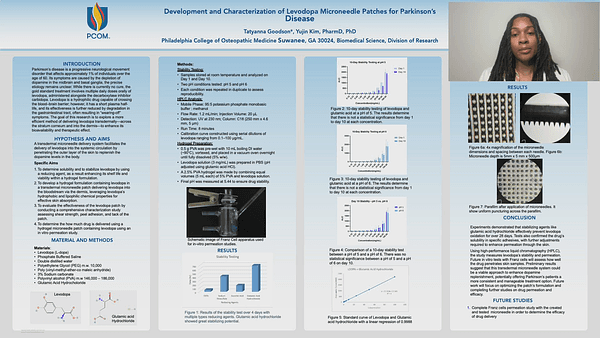
Development and Characterization of Levodopa Microneedle Patches for Parkinson's Disease

Development and Characterization of Levodopa Microneedle Patches for Parkinson's Disease

2025 AMA Research Challenge – Member Premier Access

Tatyanna Goodson
Tatyanna Goodson

22 October 2025

Stay up to date with the latest Underline news!

Select topic of interest (you can select more than one)

PRESENTATIONS

  • All Presentations
  • For Librarians
  • Resource Center
  • Free Trial
Underline Science, Inc.
1216 Broadway, 2nd Floor, New York, NY 10001, USA

© 2025 Underline - All rights reserved