2025 AMA Research Challenge – Member Premier Access

October 22, 2025

Virtual only, United States

Would you like to see your presentation here, made available to a global audience of researchers?
Add your own presentation or have us affordably record your next conference.

Background:

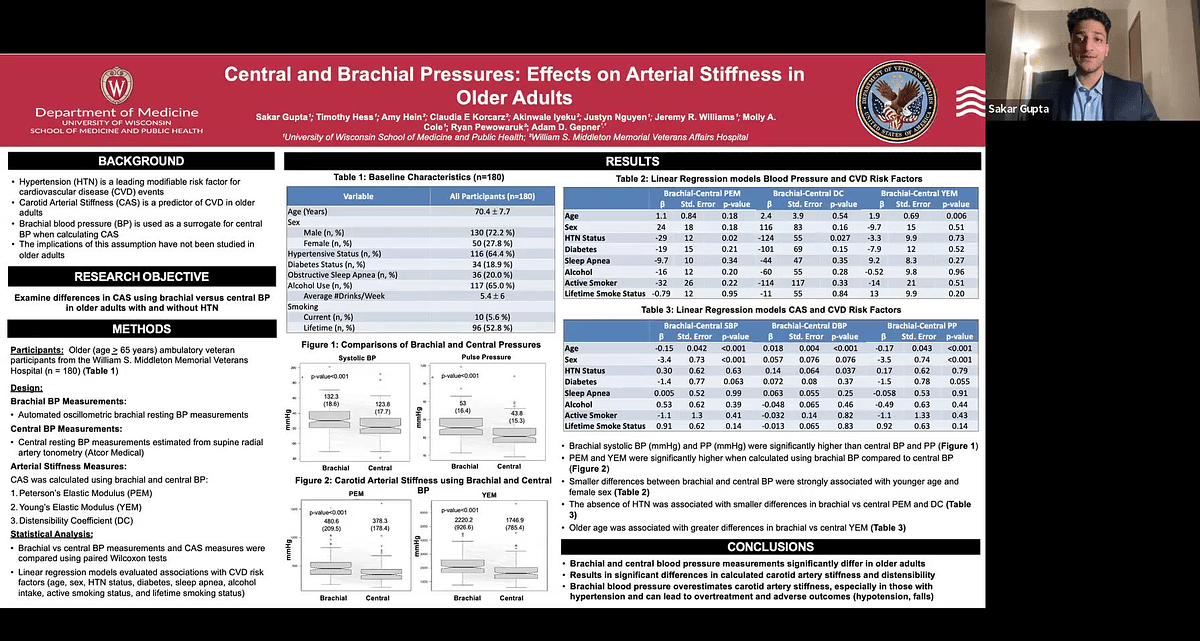
Central blood pressure (BP) more accurately reflects the loading conditions of the heart compared to brachial BP. Brachial BP is routinely used as a surrogate for central BP due to its ease of access, lower cost, and the efficiency of measurement. However, using brachial BP as a surrogate for central BP when calculating carotid arterial stiffness (CAS) has not been studied in older adults.

Methods:

Veterans (n=180) age 65+ were recruited from Madison VA Hospital. Resting supine brachial BP and central BP (estimated from radial artery waveforms, Atcor Medical) were obtained. CAS (Peterson’s elastic modulus PEM, Young’s elastic modulus YEM) and distensibility coefficient (DC) were calculated using brachial and central BP. Differences in CAS were compared using paired Wilcoxon tests. Linear regression models evaluated associations with cardiovascular risk factors (age, sex, hypertension status, diabetes, sleep apnea, alcohol intake, active smoking, and lifetime smoking status).

Results:

Participants were 70.4 (7.7) years old and 27.8% were female. Average brachial systolic BP and pulse pressure were significantly higher than central (132.3 18.6 mmHg vs 123.8 17.7 mmHg, p<0.001) and pulse pressure (53mmHg 16.4 vs 43.8mmHg 15.3, p<0.001). Compared to brachial BP, using central BP to calculate stiffness measures resulted in significantly lower YEM and PEM and significantly higher DC (PEM: 480.6 209.5 mmHg vs 378.3 178.4 mmHg; YEM: 2220.2 926.6 mmHg vs 1746.9 785.4 mmHg; DC: 2.4 1.0 x10⁻³ mmHg-1 vs 3.1 1.1 x10⁻³ mmHg-1; all p<0.001). Absence of hypertension was associated with smaller differences in PEM and DC (PEM: 𝛽=-29.1, SE=12.1, p=0.02; DC: 𝛽=-123.8, SE=55.3, p=0.027), while older age was associated with greater differences in YEM when calculated using brachial vs central BP (𝛽=1.9x10⁻⁵, SE=0.69x10⁻⁵, p=0.006).

Conclusion:

Brachial and central BP significantly differ in older adults and result in significant differences in calculated CAS and distensibility. Brachial BP tends to significantly overestimate CAS, especially in those with hypertension. Our study highlights the importance of considering central BP when evaluating CAS to predict cardiovascular health and better understand vascular aging, especially in older adults with hypertension. Relying solely on peripheral BP may lead to an overestimation of vascular risk in these populations. Future studies should prioritize using central BP measurements or CAS indices that are independent of BP to more accurately assess arterial health and improve CVD risk stratification. This can help better guide antihypertensive therapy, potentially improving outcomes and reducing the risk of over- or under-treatment.

Downloads

Transcript English (automatic)

Next from 2025 AMA Research Challenge – Member Premier Access

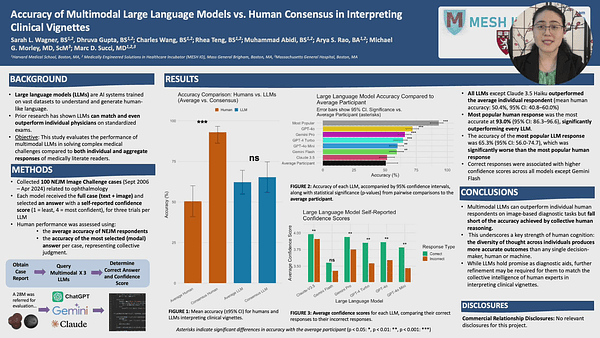
Accuracy of Multimodal Large Language Models vs. Human Consensus in Interpreting Clinical Vignettes

Accuracy of Multimodal Large Language Models vs. Human Consensus in Interpreting Clinical Vignettes

2025 AMA Research Challenge – Member Premier Access

Sarah Wagner
Sarah Wagner

22 October 2025

Stay up to date with the latest Underline news!

Select topic of interest (you can select more than one)

PRESENTATIONS

  • All Presentations
  • For Librarians
  • Resource Center
  • Free Trial
Underline Science, Inc.
1216 Broadway, 2nd Floor, New York, NY 10001, USA

© 2025 Underline - All rights reserved