2025 AMA Research Challenge – Member Premier Access

October 22, 2025

Virtual only, United States

Would you like to see your presentation here, made available to a global audience of researchers?
Add your own presentation or have us affordably record your next conference.

Background

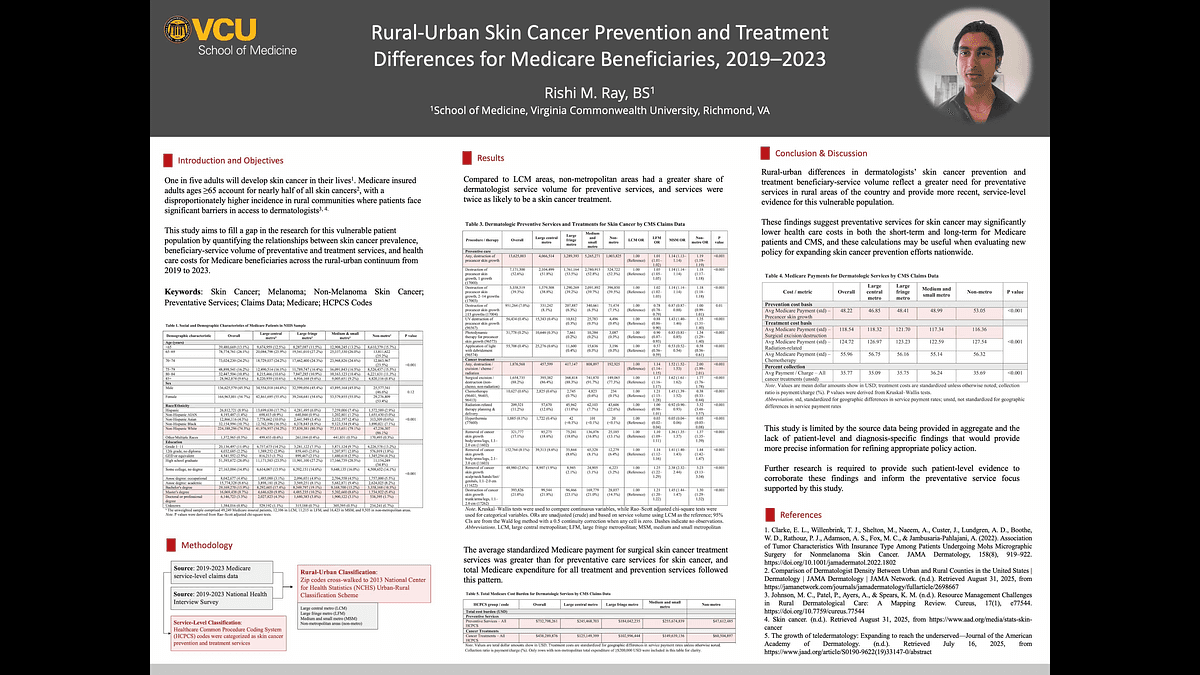
One in five adults will develop skin cancer in their lives. Medicare insured adults ages ≥65 account for nearly half of all skin cancers, with a disproportionately higher incidence in rural communities where patients face significant barriers in access to dermatologists. This study aims to fill a gap in the research for this vulnerable patient population by quantifying the relationships between skin cancer prevalence, beneficiary‑service volume of preventative and treatment services, and health care costs for Medicare beneficiaries across the rural-urban continuum from 2019 to 2023.

Methods

Retrospective analysis of the publicly available 2019-2023 Medicare claims data files and the 2019-2023 National Health Interview Survey. Healthcare Common Procedure Coding System (HCPCS) codes were categorized as skin cancer prevention and treatment services based on the American Medical Association’s CPT Consumer Friendly Descriptors.

Zip codes were cross-walked to four levels of the 2013 National Center for Health Statistics (NCHS) Urban-Rural Classification Scheme: large central metro (LCM), large fringe metro (LFM), medium and small metro (MSM), and non-metropolitan areas (non-metro).

Results

4,314 Medicare beneficiaries reported a skin cancer diagnosis in their lifetime (8.8%), with a greater incidence of each type of skin cancer in rural areas than urban areas (p<0.03).

Non‑metropolitan areas had a greater share of dermatology beneficiary‑service volume for preventive services (LCM 23.4%; LFM 23.6%; MSM 25.7%; non‑metro 26.7%; P < 0.001) and services were 2-fold more likely to be any skin cancer treatment and 3.5-fold more likely to be radiation‑related treatment (OR 2.00 1.99–2.01; 3.52 3.48–3.57) than in LCM areas.

After standardization for geographic differences in service payment rates, the average Medicare payment for surgical skin cancer treatment services was greater than for preventative care services, and both were greater in rural areas than urban areas (Overall, $118.54 vs. $48.22; LCM, $118.32 vs. $46.85; LFM, $121.7 vs. $48.41; MSM, $117.34 vs. $48.99; non-metro, $116.36 vs. $53.05; p<0.001 for each). Interestingly, no rural-urban difference was observed in radiation-related or chemotherapy treatment services (p=0.230, p=0.260).

Conclusion

Rural-urban differences in dermatologists’ skin cancer prevention and treatment beneficiary‑service volume reflect a greater need for preventative services in rural areas of the country and provide more recent, service-level evidence for this vulnerable population.

These findings suggest preventative services for skin cancer may significantly lower health care costs in both the short-term and long-term for Medicare patients and CMS, and these calculations may be useful when evaluating new policy for expanding skin cancer prevention efforts nationwide.

Downloads

Transcript English (automatic)

Next from 2025 AMA Research Challenge – Member Premier Access

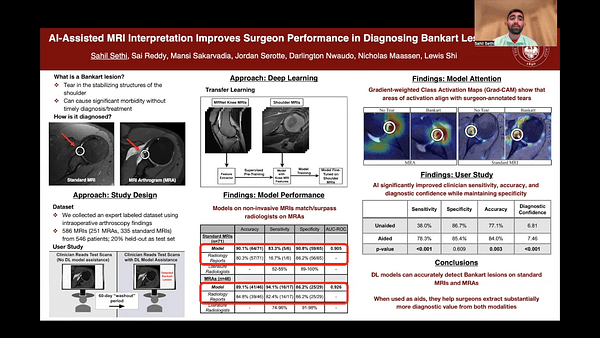
AI-Assisted MRI Interpretation Improves Surgeon Performance in Diagnosing Bankart Lesions

AI-Assisted MRI Interpretation Improves Surgeon Performance in Diagnosing Bankart Lesions

2025 AMA Research Challenge – Member Premier Access

Sahil Sethi
Sahil Sethi

22 October 2025

Stay up to date with the latest Underline news!

Select topic of interest (you can select more than one)

PRESENTATIONS

  • All Presentations
  • For Librarians
  • Resource Center
  • Free Trial
Underline Science, Inc.
1216 Broadway, 2nd Floor, New York, NY 10001, USA

© 2025 Underline - All rights reserved