2025 AMA Research Challenge – Member Premier Access

October 22, 2025

Virtual only, United States

Would you like to see your presentation here, made available to a global audience of researchers?
Add your own presentation or have us affordably record your next conference.

Background

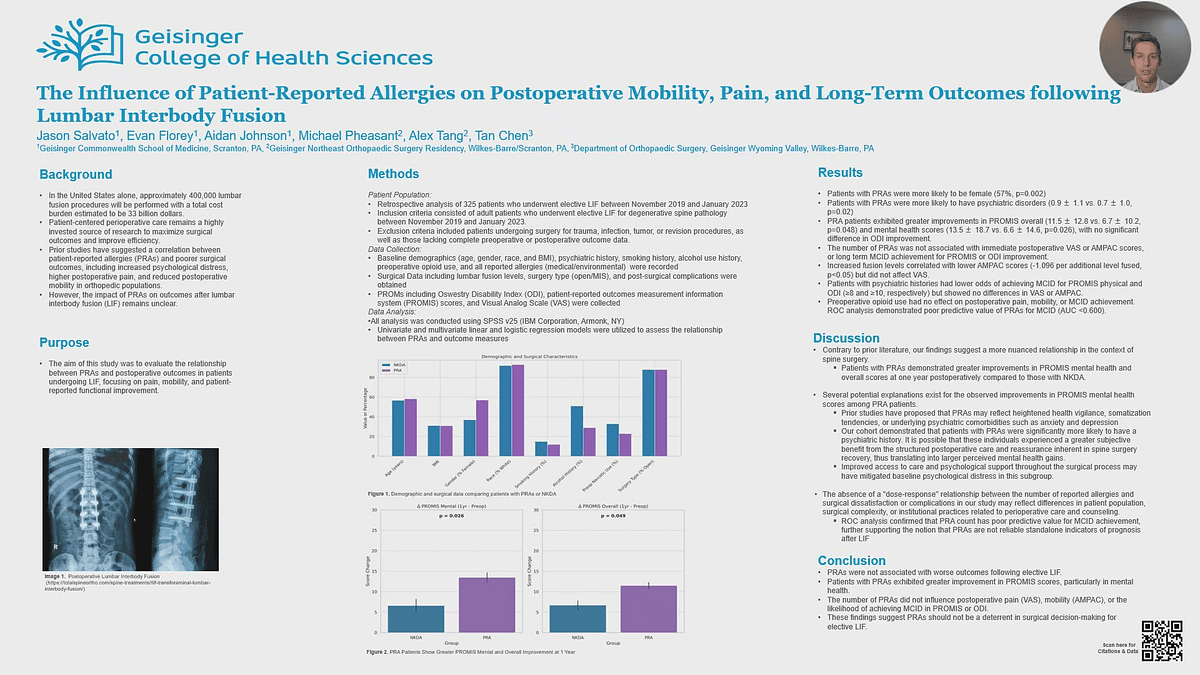
Prior studies suggest that patient-reported allergies (PRAs) may correlate with poorer surgical outcomes, including greater psychological distress, increased postoperative pain, and reduced mobility in orthopedic populations. However, the relationship between PRAs and outcomes after lumbar interbody fusion (LIF) remains unclear. This study evaluates the association between PRAs and postoperative pain, mobility, and functional improvement following LIF.

Methods

A retrospective review was conducted for patients who underwent elective LIF for degenerative spine pathology between November 2019 and January 2023. Patients were grouped by the presence of PRAs (n=242) or no known drug allergies (NKDA; n=83). Baseline demographics, psychiatric history, preoperative opioid use, and reported allergies—categorized as medical or environmental—were recorded. Primary outcomes included one-year changes in Patient-Reported Outcomes Measurement Information System (PROMIS) overall and mental health scores, and Oswestry Disability Index (ODI). Secondary outcomes included postoperative visual analog scale (VAS) pain scores and Activity Measure for Post-Acute Care (AMPAC) scores. Associations were assessed using univariate and multivariate regression models. Receiver operating characteristic (ROC) analysis evaluated the predictive value of PRA count for achieving minimal clinically important difference (MCID) in PROMIS and ODI scores.

Results

Patients with PRAs were more likely to be female (57%, p=0.002) and have psychiatric histories (0.9 ± 1.1 vs. 0.7 ± 1.0, p=0.02). PRA patients had greater improvement in PROMIS overall (11.5 ± 12.8 vs. 6.7 ± 10.2, p=0.048) and mental health scores (13.5 ± 18.7 vs. 6.6 ± 14.6, p=0.026). ODI improvement did not differ significantly. PRA count was not associated with VAS, AMPAC, or MCID achievement in PROMIS or ODI. Increasing fusion levels negatively impacted AMPAC scores (-1.096 per level fused, p<0.05) but not VAS. Psychiatric history reduced odds of achieving MCID for PROMIS physical and ODI scores, while preoperative opioid use had no impact on pain, mobility, or MCID outcomes. ROC analysis showed poor predictive value of PRA count for MCID (AUC <0.600).

Conclusion

PRAs were not associated with worse outcomes following LIF. Instead, patients with PRAs experienced greater improvements in PROMIS, particularly in mental health. PRA count did not affect postoperative pain, mobility, or MCID achievement. These findings suggest that the presence or quantity of PRAs should not deter clinicians from recommending lumbar fusion surgery.

Downloads

Transcript English (automatic)

Next from 2025 AMA Research Challenge – Member Premier Access

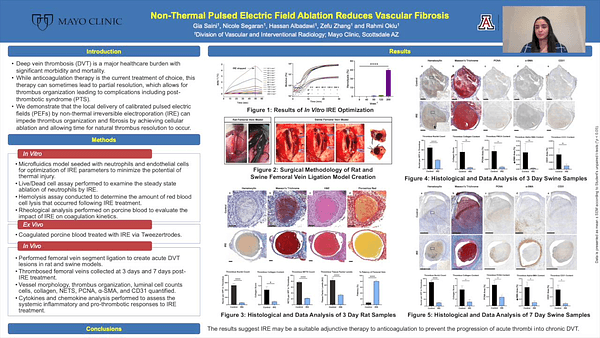
Non-Thermal Pulsed Electric Field Ablation of Blood Clots Reduces Fibrosis

Non-Thermal Pulsed Electric Field Ablation of Blood Clots Reduces Fibrosis

2025 AMA Research Challenge – Member Premier Access

Gia Saini
Gia Saini

22 October 2025

Stay up to date with the latest Underline news!

Select topic of interest (you can select more than one)

PRESENTATIONS

  • All Presentations
  • For Librarians
  • Resource Center
  • Free Trial
Underline Science, Inc.
1216 Broadway, 2nd Floor, New York, NY 10001, USA

© 2025 Underline - All rights reserved