2025 AMA Research Challenge – Member Premier Access

October 22, 2025

Virtual only, United States

Would you like to see your presentation here, made available to a global audience of researchers?
Add your own presentation or have us affordably record your next conference.

Background

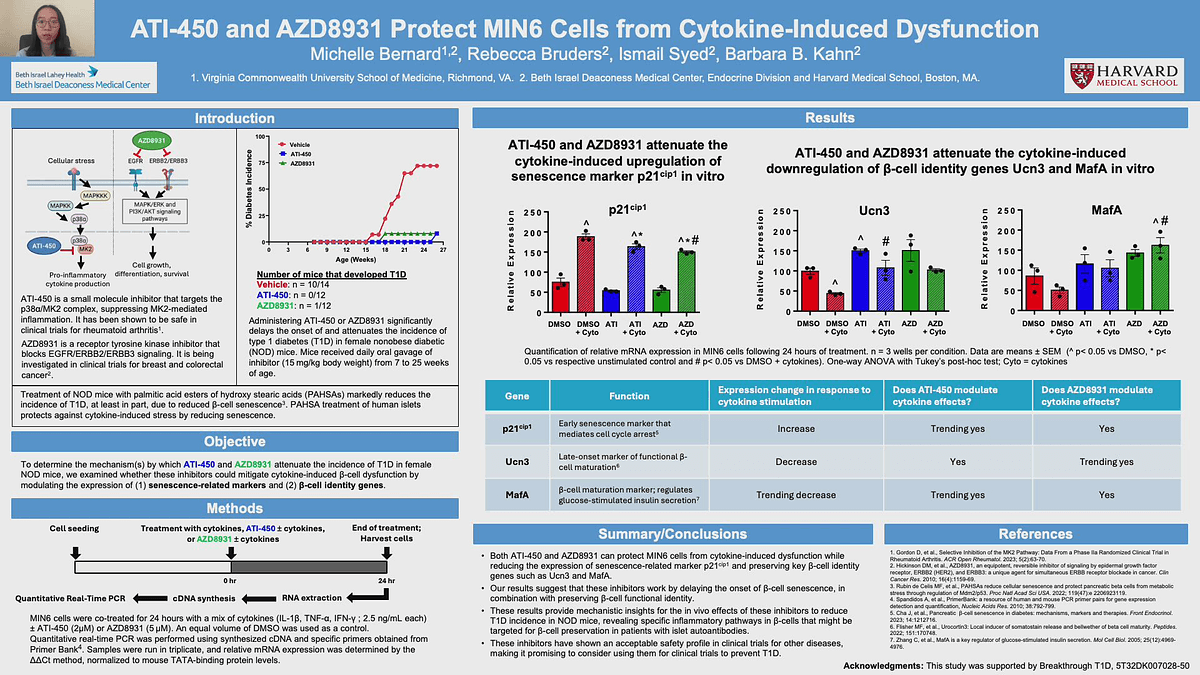
Type 1 diabetes (T1D) is characterized by autoimmune-mediated destruction of pancreatic β cells, leading to progressive loss of β-cell function and insulin deficiency. Crosstalk between the immune system and β-cell signaling contributes to disease progression, highlighting inflammatory pathways as potential therapeutic targets. While the development of an anti-CD3 monoclonal antibody against autoreactive T cells represents a significant advance in delaying the onset of insulin dependence, new approaches are needed to delay β-cell destruction in patients with diabetes-related autoantibodies. Our lab previously showed that ATI-450, a selective p38α/MK2 inhibitor, and AZD8931, an EGFR/ERBB2/ERBB3 inhibitor, delay the onset and reduce the incidence of T1D in female nonobese diabetic (NOD) mice. To explore the mechanism(s) by which ATI-450 and AZD8931 attenuate T1D, we examined whether these inhibitors could mitigate cytokine-induced β-cell dysfunction by modulating the expression of senescence-related markers and β-cell identity/function genes.

Methods

MIN6 cells were co-treated for 24 hours with cytokines (IL-1β, TNF-α, IFN-γ; 2.5 ng/mL each) ± ATI-450 (2µM) or AZD8931 (5 µM). DMSO was used as a control. Total RNA was extracted and reverse-transcribed into cDNA using standard kits. Quantitative real-time PCR was performed using synthesized cDNA and primers obtained from PrimerBank. Samples were run in triplicate, and relative mRNA expression was determined by the ΔΔCt method, normalized to mouse TATA-binding protein levels.

Results

Cytokine-stress increased the relative expression of the senescence-related marker p21cip1 by 2.5-fold compared to DMSO control. Co-treatment with either ATI-450 or AZD8931 attenuated this cytokine-induced upregulation, suggesting that these inhibitors may delay the onset of senescence by blocking pro-inflammatory signaling pathways. Cytokine-stress reduced the relative expression of the β-cell identity/function genes Ucn3 and MafA by ~2.0-fold and ~1.5-fold, respectively, compared to DMSO control. Co-treatment with either ATI-450 or AZD8931 attenuated the cytokine-induced downregulation of Ucn3 and MafA, indicating that these compounds may help preserve β-cell functional identity.

Conclusion

These findings suggest that both ATI-450 and AZD8931 can protect MIN6 cells from cytokine-induced dysfunction in vitro by reducing expression of the senescence-related marker p21cip1 and preserving key β-cell identity/function genes such as Ucn3 and MafA. This provides mechanistic insights for the in vivo effects of these inhibitors to reduce T1D incidence in NOD mice, revealing specific inflammatory pathways in β-cells that might be targeted for β-cell preservation. Since both inhibitors demonstrated favorable safety profiles in clinical trials for other diseases, these compounds could be investigated for preventing T1D in islet autoantibody-positive individuals.

Downloads

Transcript English (automatic)

Next from 2025 AMA Research Challenge – Member Premier Access

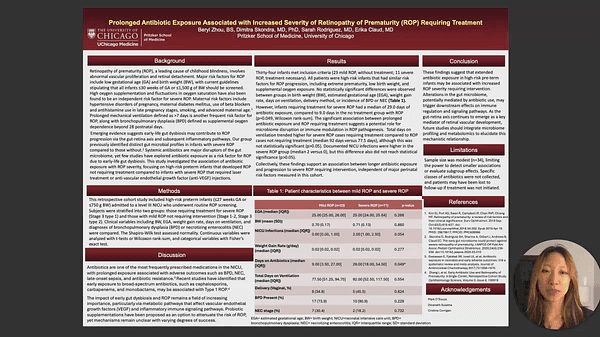
Prolonged Antibiotic Exposure Associated with Increased Severity of Retinopathy of Prematurity (ROP) Requiring Treatment

Prolonged Antibiotic Exposure Associated with Increased Severity of Retinopathy of Prematurity (ROP) Requiring Treatment

2025 AMA Research Challenge – Member Premier Access

Beryl Zhou

22 October 2025

Stay up to date with the latest Underline news!

Select topic of interest (you can select more than one)

PRESENTATIONS

  • All Presentations
  • For Librarians
  • Resource Center
  • Free Trial
Underline Science, Inc.
1216 Broadway, 2nd Floor, New York, NY 10001, USA

© 2025 Underline - All rights reserved