Would you like to see your presentation here, made available to a global audience of researchers?
Add your own presentation or have us affordably record your next conference.
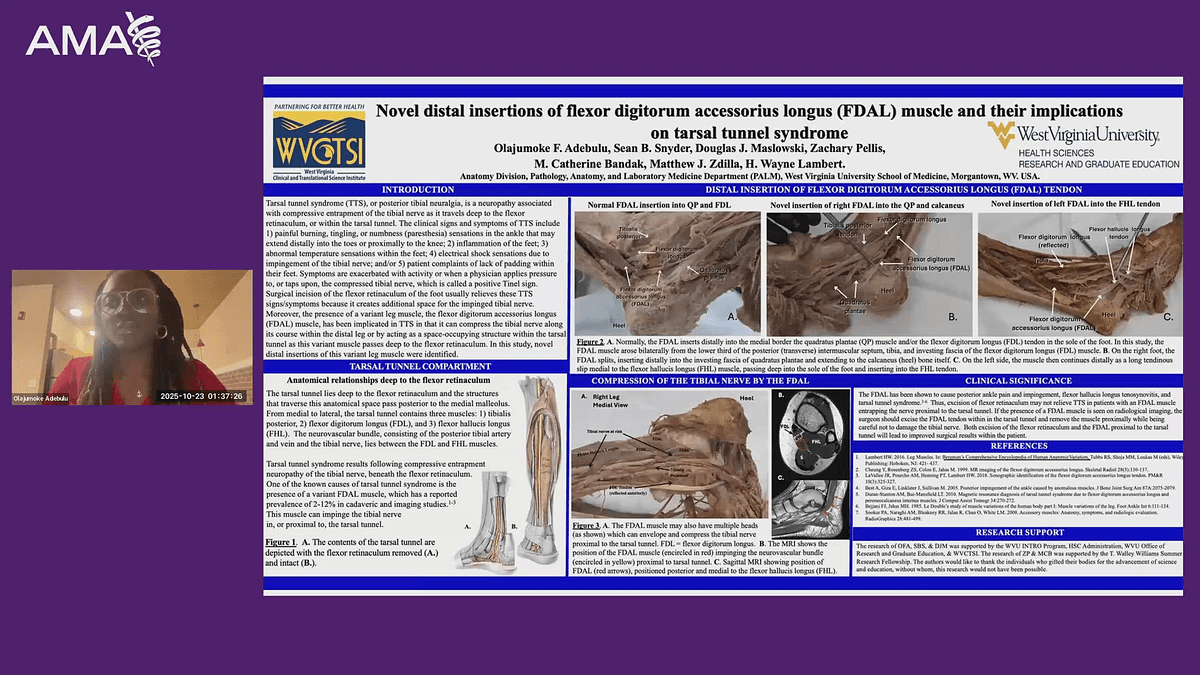
Tarsal tunnel syndrome (TTS), or posterior tibial neuralgia, is a neuropathy associated with compressive entrapment of the tibial nerve as it travels deep to the flexor retinaculum, or within the tarsal tunnel. The clinical signs and symptoms of a patient with TTS include: 1) painful burning, tingling, or numbness (paresthesia) sensations in the ankle the may extend distally into the toes or proximally to the knee; 2) inflammation of the feet; 3) abnormal temperature sensations within the feet; 4) electrical shock sensations due to impingement of the tibial nerve; and/or 5) patient complaints of lack of padding within the feet.1-5 These symptoms are exacerbated during physical activity or when a physician taps upon, or applies pressure to, the compressed tibial nerve, which is called a positive Tinel sign. Surgical incision of the flexor retinaculum of the foot usually relieves these TTS signs/symptoms because it creates additional space within the fibro-osseous passage for the impinged tibial nerve. Moreover, the presence of a variant leg muscle, the flexor digitorum accessorius longus (FDAL) muscle, has been implicated in TTS in that it can compress the tibial nerve along its course within the distal leg or by acting as a space-occupying structure within the tarsal tunnel as this supernumerary muscle passes deep to the flexor retinaculum. This muscular variant, which is present in 2-12% in cadaveric and imaging studies, should be ruled out before surgical incision of the flexor retinaculum, or these TTS signs/symptoms may persist.1,6-7 In this study of the FDAL muscle, novel distal insertions of this variant leg muscle were identified. We also describe the FDAL muscle in detail, share its anatomical relationship within the distal leg, and explain how the presence of this supernumerary muscle may predispose a patient to tarsal tunnel syndrome.