2025 AMA Research Challenge – Member Premier Access

October 22, 2025

Virtual only, United States

Would you like to see your presentation here, made available to a global audience of researchers?
Add your own presentation or have us affordably record your next conference.

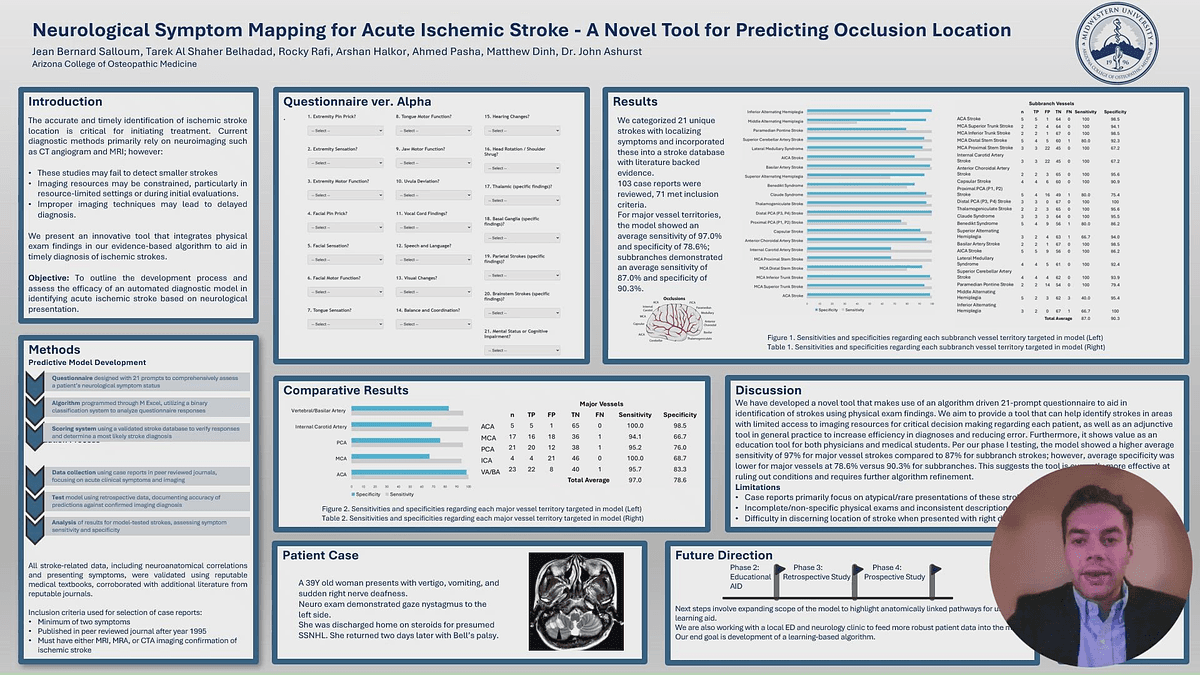
Abstract Title Neurological Symptom Mapping for Acute Ischemic Stroke - A Novel Tool for Predicting Occlusion Location Jean Bernard Salloum, Tarek Belhadad, Matthew Dinh, Rocky Rafi, Arshan Halkor, Ahmed Pasha, Dr. John Ashurst

Background Timely stroke localization is critical for effective treatment; however, CTA—the current standard for identifying vessel occlusions—has accessibility and diagnostic limitations. Only 39% of frontier hospitals have 24-hour CT access, and over 20% of the population lives more than an hour from advanced stroke centers. Rural patients are half as likely to receive thrombolytics and one-third less likely to undergo thrombectomy than urban patients. Even with CTA available, renal impairment, patient stability, and motion artifacts limit efficacy. To address this, we developed a questionnaire with an embedded algorithm that translates overlooked clinical signs into stroke localization. As a non-imaging tool, our tool may support rapid diagnostic and treatment decisions when CTA is delayed or inconclusive.

Methods To construct a clinically grounded model for ischemic stroke localization, we integrated major neurovascular territories, clinical syndromes, and symptoms into a stroke database. Validation was performed using reputable medical textbooks corroborated with data from peer-reviewed literature. This provided a framework to program our software - encoded with a structured clinical questionnaire and algorithm that predicts ischemic stroke locations.

To evaluate accuracy of the algorithm, we curated a validation dataset from published peer reviewed case reports (2000–present). Inclusion criteria for cases required documentation of at least two focal neurological signs and confirmatory imaging findings (CT or MRI).

We implemented a triple-blind protocol for testing to minimize bias: • Researcher A extracted clinical data and imaging results from reports. • Researcher B entered anonymized clinical data into the algorithm. • Researcher C analyzed algorithm predicted stroke locations as compared to imaging confirmed locations.

Results The stroke database included 21 ischemic strokes with characteristic symptomology. We identified 103 potential case reports for algorithm testing, of which 77 met inclusion criteria. Regarding major vessel territories, such as the MCA, ACA, PCA, ICA and Basilar Artery, the model demonstrated an average sensitivity of 97.0% and specificity of 78.6%. For each of their respective sub-branches, an average sensitivity of 87.0% and specificity of 90.3% was achieved. Of note, lacunar infarcts showed a sensitivity of 100% and specificity of 90.9%.

Conclusion Our model demonstrated high sensitivity for major vessel strokes and strong specificity for sub-branch level infarcts. Notably, it accurately detected deep, diagnostically challenging infarcts such as brainstem or lacunar strokes with consistent reliability. These findings support the model's potential to enable early and accurate stroke localization using physical exam findings, which may assist in triage and initiating treatment in settings with limited imaging access or ambiguous findings.

Downloads

Transcript English (automatic)

Next from 2025 AMA Research Challenge – Member Premier Access

Developing a Nanoparticle Drug Delivery System to Treat Preterm Labor

Developing a Nanoparticle Drug Delivery System to Treat Preterm Labor

2025 AMA Research Challenge – Member Premier Access

Lauren Link

22 October 2025

Stay up to date with the latest Underline news!

Select topic of interest (you can select more than one)

PRESENTATIONS

  • All Presentations
  • For Librarians
  • Resource Center
  • Free Trial
Underline Science, Inc.
1216 Broadway, 2nd Floor, New York, NY 10001, USA

© 2025 Underline - All rights reserved