Would you like to see your presentation here, made available to a global audience of researchers?
Add your own presentation or have us affordably record your next conference.
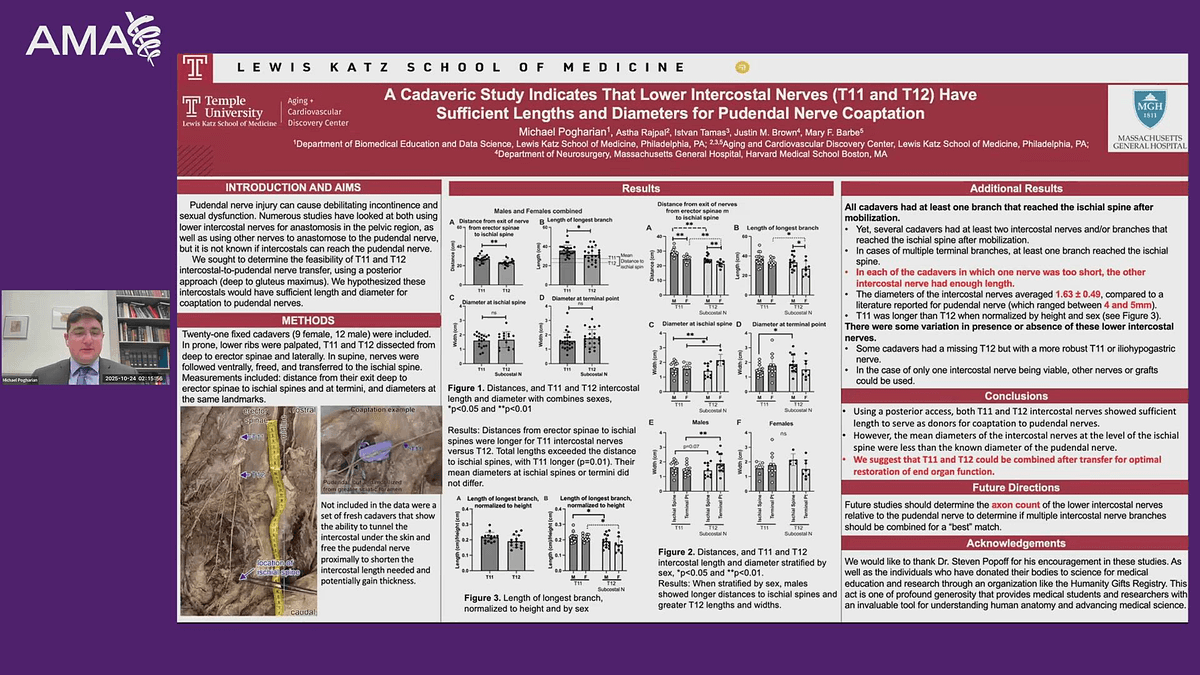
Abstract Title A Cadaveric Study Indicates That Lower Intercostal Nerves (T11 and T12) Have Sufficient Lengths and Diameters for Pudendal Nerve Coaptation
Background Pudendal nerve injury can cause debilitating bladder and fecal incontinence and sexual dysfunction. It is known that intercostal nerves can be transferred to S2-S3 roots for functional restoration. We sought to determine the feasibility of T11 and T12 intercostal-to-pudendal nerve transfer, using a posterior approach (deep to gluteus maximus). We hypothesized the intercostals would have sufficient tensionless length and diameter for coaptation to pudendal nerves.
Methods Twenty-one fixed cadavers (9 female, 12 male) were included. With cadavers prone, lower ribs were palpated, and T11/T12 were dissected from deep to erector spinae muscles and followed laterally. After repositioning supine, nerves were followed ventrally, freed, and “transferred” to the ischial spine. Measurements included: distance from intercostal nerve exits from erector spinae to ischial spines and to terminus, and diameters at the same landmarks. Mixed-effects model statistics were used.
Results Distances from the erector spinae to ischial spines were longer for T11 than for T12; total lengths exceeded the distance to ischial spines; and T11 was longer than T12 (p=0.01). Mean diameters of T11/T12 at ischial spines or termini did not differ. When data was stratified by sex, distances to ischial spines were longer in males, as was T12’s total length. Male T12 nerves were wider at terminus. In cases of multiple terminal branches, at least one branch reached the ischial spine.
Conclusion Using a posterior access, both T11 and T12 showed sufficient length and diameter to serve as donor nerves for coaptation to pudendal nerves. The diameter of each intercostal nerve at the level of the pudendal was less than the known diameter of the pudendal nerve. We suggest that T11 and T12 could be combined post-transfer for optimal restoration of end-organ function.