2025 AMA Research Challenge – Member Premier Access

October 22, 2025

Virtual only, United States

Would you like to see your presentation here, made available to a global audience of researchers?
Add your own presentation or have us affordably record your next conference.

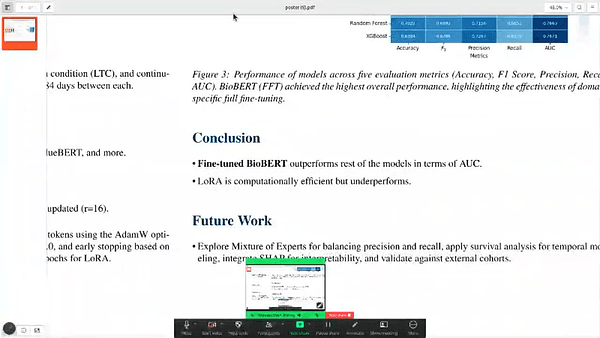
Background Chronic Kidney Disease of unknown etiology (CKDu) is a progressive form of kidney damage that disproportionately affects agricultural communities in Sri Lanka, Central America, and parts of India, with emerging hotspots also suspected in the South and Western United States. Despite extensive investigation, the underlying causes of CKDu remain unclear, partly because of a potential long lag between exposure and eventual symptomatic presentation of kidney disease. We applied machine learning (ML) and large language models (LLMs) to explore predictive tools for disease progression in a cohort of persons with CKDu, with the hypothesis that early identification of persons likely to experience kidney function decline will facilitate investigation of proximal (causative) exposures. Methods We analyzed baseline data (labs demographics) from 244 participants enrolled in Kidney Progression Project (KiPP), a prospective cohort of farmworkers with kidney disease in Sri Lanka launched in 2018. Among these participants, 22 progressed to the study’s primary outcome (eGFR<15 mL/min/1.73 m²) by the year 2024. For model development, we used data from the first 2.5 years of follow-up. We developed and optimized several ML classifiers including logistic regression, support vector machines, random forests, and XGBoost. Each model was trained using stratified five-fold cross-validation, and class imbalance was addressed using SMOTE-based oversampling. To identify underlying patterns in the dataset, we applied unsupervised models like K-means clustering(k=7), and the resulting cluster labels were included as categorical features in supervised learning models. Model performance was evaluated using standard classification metrics, and interpretability was assessed using SHAP (SHapley Additive exPlanations). Additionally, we used clinical vignettes from KiPP data to evaluate the predictive capabilities of LLMs. We tested five LLMs through SecureGPT on their ability to predict progression. Results The best performing ML model was an XGBoost classifier (ROC-AUC= 0.84; F1 score= 0.48). SHAP analysis identified cluster membership and serum uric acid as key predictors. Among the LLMs, GPT 4.5 performed best (Accuracy= 87%; F1 score of 0.42). Both models outperformed existing methods (eGFR slope, Accuracy=67%, F1 score=0.23). Conclusion Our findings demonstrate that both traditional ML models and LLMs can predict CKDu progression from limited clinical data. Custom-tailored ML models slightly outperformed generative AI models such as GPT-4.5. With continued refinement, these tools may not only support early identification of high risk individuals but also aid in identifying causes of CKDu. Future directions include external validation using ongoing international cohorts and incorporation of longitudinal laboratory data to generate clinically-deployable AI tools.

Next from 2025 AMA Research Challenge – Member Premier Access

Seizure Dynamotype Patterns Predict Drug Response in Animal Models of Epilepsy

Seizure Dynamotype Patterns Predict Drug Response in Animal Models of Epilepsy

2025 AMA Research Challenge – Member Premier Access

Ashley Zachery-Savella

22 October 2025

Stay up to date with the latest Underline news!

Select topic of interest (you can select more than one)

PRESENTATIONS

  • All Presentations
  • For Librarians
  • Resource Center
  • Free Trial
Underline Science, Inc.
1216 Broadway, 2nd Floor, New York, NY 10001, USA

© 2025 Underline - All rights reserved