Would you like to see your presentation here, made available to a global audience of researchers?
Add your own presentation or have us affordably record your next conference.
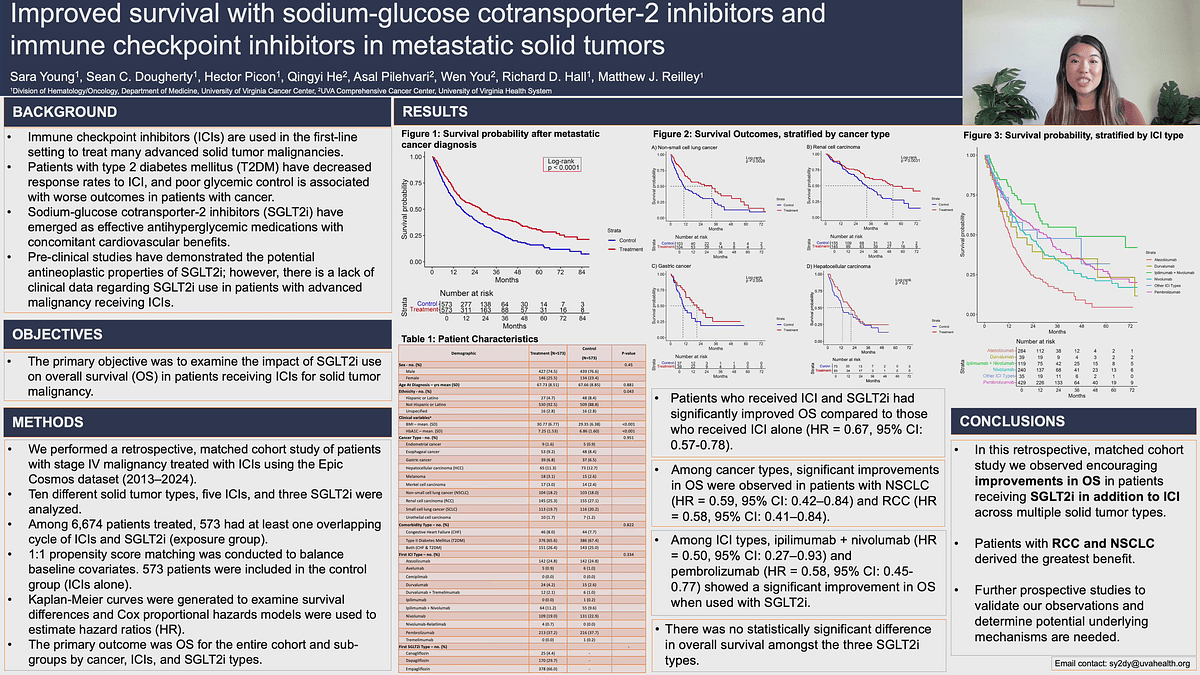
Background Immune checkpoint inhibitors (ICI) are first-line treatments for many advanced solid tumors. Patients with type 2 diabetes mellitus (T2DM) have decreased response rates to ICI, and poor glycemic control is associated with worse outcomes in cancer patients. Further adjunctive therapies to enhance ICI efficacy are needed.
Sodium-glucose cotransporter-2 inhibitors (SGLT2i) have emerged as effective antihyperglycemic medications with concomitant cardiovascular benefits. SGLT2i are now approved in patients with T2DM and congestive heart failure (CHF). Pre-clinical studies suggest SGLT2i may help slow tumor growth in-vitro and in-vivo; however, there is a lack of clinical data regarding SGLT2i use in patients with advanced malignancy receiving ICI.
Methods We performed a retrospective, matched cohort study of patients with stage IV malignancy and T2DM or CHF, who were treated with ICI using Epic Cosmos dataset (2013–2024). Ten solid tumor types, five ICI, and three SGLT2i were analyzed. Among 6,674 patients treated with ICI, 573 had at least one overlapping cycle of ICI and SGLT2i. 1:1 propensity score matching was conducted to balance baseline covariates, including cancer type, comorbidities, age at diagnosis, and sex. Kaplan-Meier curves were generated to examine survival differences, and Cox proportional hazards models were used to estimate hazard ratios (HR). The primary outcome was overall survival (OS) for the entire matched cohort and sub-groups by cancer, ICI, and SGLT2i types.
Results Patients who received ICI and SGLT2i had significantly improved OS compared to those who received ICI alone (HR = 0.67, 95% CI: 0.57-0.78). Among cancer types, significant improvements in survival were observed in patients with renal cell carcinoma (RCC, HR = 0.58, 95% CI: 0.41–0.84) and non-small cell lung cancer (NSCLC, HR = 0.59, 95% CI: 0.42–0.84). Among ICI types, ipilimumab + nivolumab (HR = 0.50, 95% CI: 0.27-0.93) and pembrolizumab (HR = 0.58, 95% CI: 0.45-0.77) showed a significant improvement in survival when used with SGLT2i. There was no statistically significant difference in OS amongst the three SGLT2i types.
Conclusion We observed encouraging improvements in OS in patients with T2DM or CHF receiving SGLT2i in addition to ICI across multiple solid tumor types. Patients with RCC and NSCLC derived the greatest benefit. Patients treated with either ipilimumab + nivolumab or pembrolizumab had the best responses to therapy. SGLT2i may be beneficial as adjunctive therapies in patients with advanced malignancy receiving ICI. Further prospective studies are needed to validate our observations and determine potential underlying mechanisms.
Downloads
Next from 2025 AMA Research Challenge – Member Premier Access
Hemodynamic Responses to Combined Ice-cold Water Intake, Leg Raising, and the Diving Response in Young Healthy Subjects – A Potential Intervention to Convert Paroxysmal Atrial Fibrillation.
2025 AMA Research Challenge – Member Premier Access
22 October 2025