2025 AMA Research Challenge – Member Premier Access

October 22, 2025

Virtual only, United States

Would you like to see your presentation here, made available to a global audience of researchers?
Add your own presentation or have us affordably record your next conference.

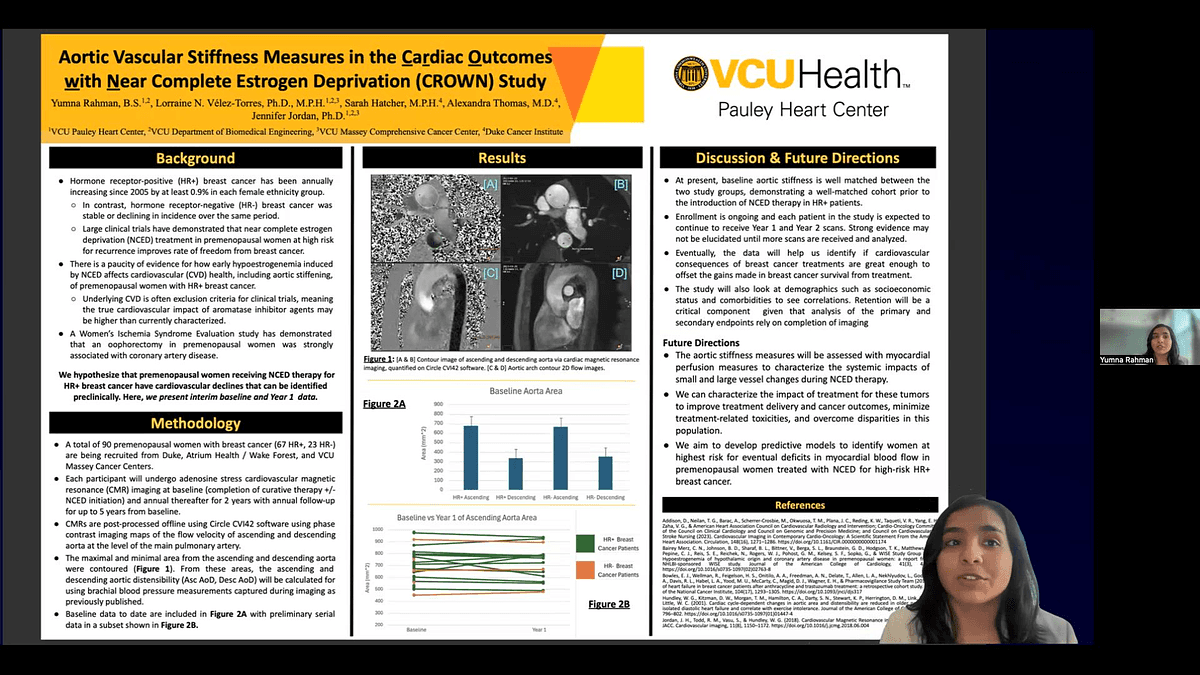
Background: Hormone receptor-positive (HR+) breast cancer has increased annually since 2005 by at least 0.9% in each female ethnicity group. In contrast, hormone receptor-negative (HR-) breast cancer was stable or declining in incidence over the same period. Clinical trials have demonstrated that near complete estrogen deprivation (NCED) treatment in premenopausal women at high risk for recurrence improves rate of freedom from breast cancer. There is insufficient evidence for how early hypo-estrogenemia by NCED affects cardiovascular health, including aortic stiffening, of premenopausal women with HR+ breast cancer. Underlying cardiovascular disease often falls in exclusion criteria for clinical trials, meaning the true cardiovascular impact of aromatase inhibitor agents may be higher than characterized. Prior studies demonstrated that an oophorectomy in premenopausal women was strongly associated with coronary artery disease. We hypothesize that premenopausal women receiving NCED therapy for HR+ breast cancer have cardiovascular declines that can be identified pre-clinically. We present interim baseline and Year 1 data to begin answering this clinical question.  Methods: 90 premenopausal women with breast cancer (67 HR+, 23 HR-) are being recruited from Duke, Wake Forest, and VCU Cancer Centers. Each participant undergoes adenosine stress cardiovascular magnetic resonance (CMR) imaging at baseline (completion of curative therapy +/- NCED initiation) and annually thereafter for 2 years with annual scans up to 5 years from baseline. CMRs are post-processed offline using Circle CVI42 software using phase contrast imaging maps of the flow velocity of ascending and descending aortas at the main pulmonary artery level. Maximal and minimal area from the ascending and descending aorta were contoured. From these areas, ascending and descending aortic distensibility is calculated using brachial blood pressure. Results: At present, baseline aortic stiffness is well matched between the two study groups, demonstrating a well-matched cohort prior to introduction of NCED therapy in HR+ patients. Enrollment is ongoing and each patient in the study is expected to continue to receive Year 1 and 2 scans. Conclusion: The data will help us identify if cardiovascular consequences of breast cancer treatments are great enough to offset the gains made in breast cancer survival from treatment. This incoming data can characterize the impact of treatment for these tumors to improve treatment delivery and cancer outcomes, minimize treatment-related toxicities, and overcome disparities in this population. We aim to develop predictive models to identify women at highest risk for eventual deficits in myocardial blood flow in premenopausal women treated with NCED for HR+ breast cancer.

Downloads

Transcript English (automatic)

Next from 2025 AMA Research Challenge – Member Premier Access

Separating Skin: A rare case of Staph Scalded Skin Syndrome in an Adult

Separating Skin: A rare case of Staph Scalded Skin Syndrome in an Adult

2025 AMA Research Challenge – Member Premier Access

Stetson Van Matre

22 October 2025

Stay up to date with the latest Underline news!

Select topic of interest (you can select more than one)

PRESENTATIONS

  • All Presentations
  • For Librarians
  • Resource Center
  • Free Trial
Underline Science, Inc.
1216 Broadway, 2nd Floor, New York, NY 10001, USA

© 2025 Underline - All rights reserved