Would you like to see your presentation here, made available to a global audience of researchers?
Add your own presentation or have us affordably record your next conference.
Background Postoperative nausea and vomiting (PONV) is a common adverse event during the perioperative period. It leads to delayed recovery, patient dissatisfaction, and increased hospital costs. This study aims to identify optimal antiemetic use in laparoscopic surgery to prevent hospitalization due to postoperative nausea and vomiting.
Methods A retrospective chart review was conducted over a 28-month period (January 2022 to April 2024) analyzing patients who underwent either a laparoscopic hysterectomy or a robotic prostatectomy at IU Health University Hospital. Demographic data, surgery duration and time of discharge were collected for every case. Antiemetic administration was recorded, including specific agent, dosage, frequency, and timing. Exclusion criteria included patients who received scopolamine patches, aprepitant, or total IV anesthetic. To minimize selection bias, only patients who received intraoperative dexamethasone were included. A total of 522 cases met the initial inclusion criteria, with 470 cases included after applying the exclusion criteria.
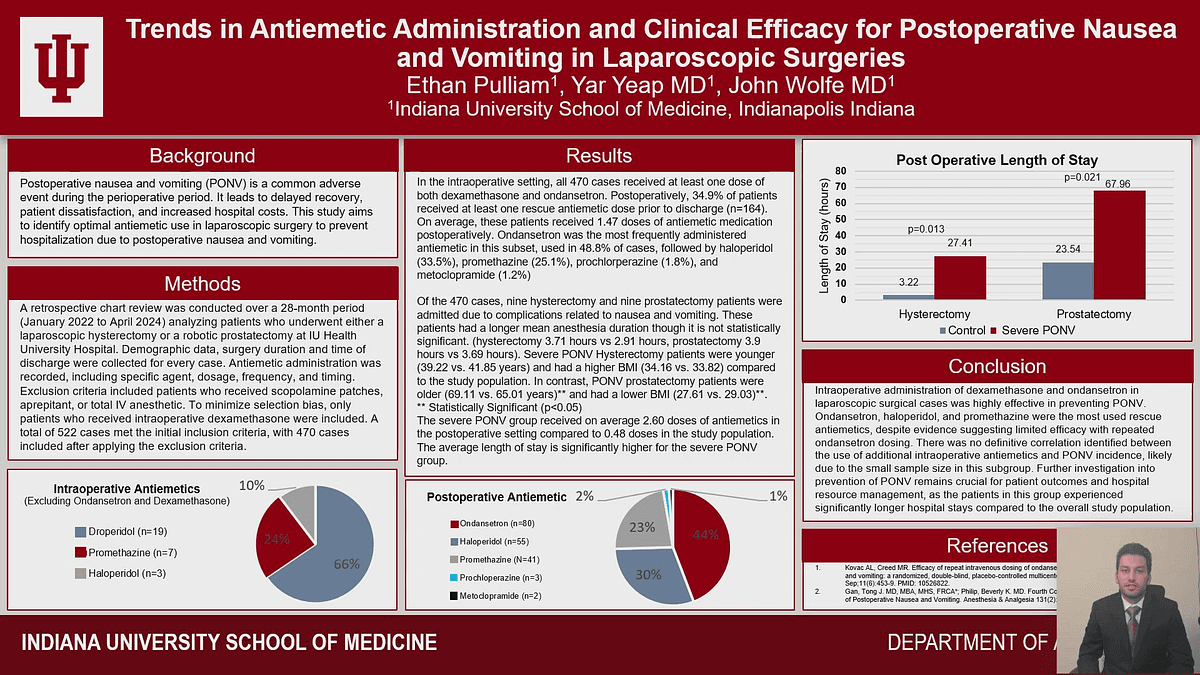
Results In the intraoperative setting, all 470 cases received at least one dose of both dexamethasone and ondansetron. Promethazine was administered intraoperatively in 1.49% (n=7) of cases, droperidol in 4.04% (n=19), and haloperidol in 0.43% (n=2). A total of 28 patients received additional intraoperative antiemetics beyond the standard dexamethasone and ondansetron regimen, of whom 3 patients required hospitalization for PONV.
Postoperatively, 34.9% of patients received at least one rescue antiemetic dose prior to discharge (n=164). On average, these patients received 1.47 doses of antiemetic medication postoperatively. Ondansetron was the most frequently administered antiemetic in this subset, used in 48.8% of cases, followed by haloperidol (33.5%), promethazine (25.1%), droperidol (1.2%), and prochlorperazine (1.2%).
Of the 470 cases, nine hysterectomy and nine prostatectomy patients were admitted due to complications related to nausea and vomiting. These patients had a longer mean anesthesia duration though it is not statistically significant. (hysterectomy 3.71 hours vs 2.91 hours, prostatectomy 3.9 hours vs 3.69 hours). Severe PONV hysterectomy patients were younger (39.22 vs. 41.85 years) and had a higher BMI (34.16 vs. 33.82) compared to the study population. In contrast, PONV prostatectomy patients were older (69.11 vs. 65.01 years) and had a lower BMI (27.61 vs. 29.03). ** Statistically Significant (p<0.05)
The severe PONV group received on average 2.60 doses of antiemetics in the postoperative setting compared to 0.48 doses in the study population. The average length of stay for the severe PONV hysterectomy patients was 27.41 hours, compared to 3.22 hours in the overall study population. For the severe PONV prostatectomy patients, the average length of stay was 67.96 hours, compared to 23.52 hours in the study population.
Conclusion Intraoperative administration of dexamethasone and ondansetron in laparoscopic surgical cases was highly effective in preventing PONV. Ondansetron, haloperidol, and promethazine were the most used rescue antiemetics, despite evidence suggesting limited efficacy with repeated ondansetron dosing. There was no definitive correlation identified between the use of additional intraoperative antiemetics and PONV incidence, likely due to the small sample size in this subgroup. The length of anesthesia positively correlated with increased risk of PONV in both hysterectomy and prostatectomy groups. Further investigation into prevention of PONV remains crucial for patient outcomes and hospital resource management, as the patients in this group experienced significantly longer hospital stays compared to the overall study population.